
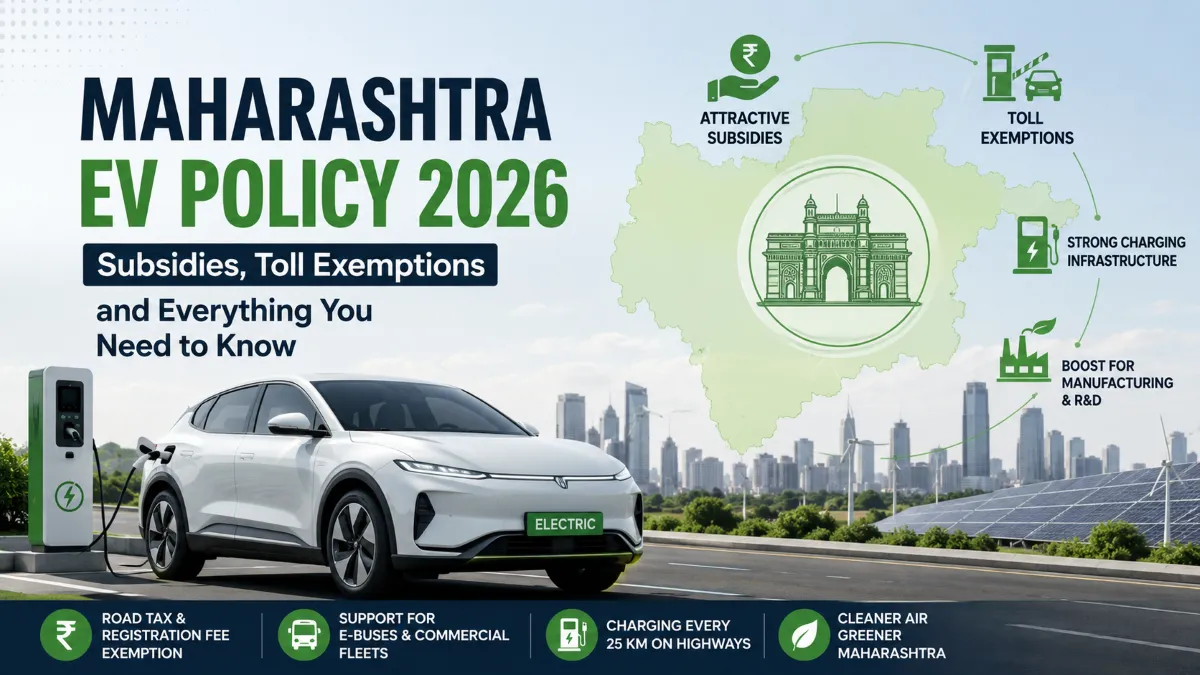
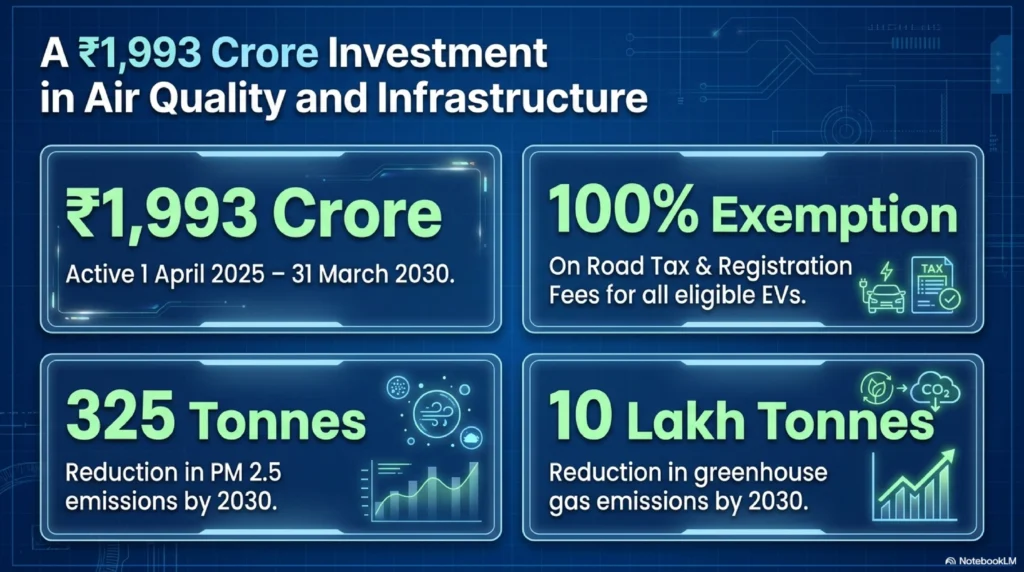
Maharashtra has put serious money behind its EV push. With a budget of ₹1,993 crore and a roadmap running from April 2025 to March 2030, the Maharashtra EV Policy 2025 is one of the more detailed and better-funded state EV policies India has seen so far.
It covers the full chain — purchase subsidies, road tax and registration exemptions, toll waivers on major expressways, charging infrastructure mandates, manufacturing incentives, and even R&D funding. Whether you are planning to buy an electric scooter, run an EV fleet, or set up a charging station, this policy has something relevant for you.
Maharashtra EV Policy 2025: Quick Overview
| Particulars | Details |
| Policy Name | Maharashtra Electric Vehicle Policy 2025 |
| Validity | 1 April 2025 – 31 March 2030 |
| Budget Allocation | ₹1,993 crore |
| Road Tax Exemption | 100% |
| Registration Fee Exemption | 100% |
| Toll Exemption | 100% on selected expressways and highways |
| EV Target by 2030 | 30% of all new vehicle registrations |
Why Maharashtra Brought in a New EV Policy
Cities like Mumbai, Pune, Nagpur and Nashik face serious air quality problems, with road transport being a major contributor. The state government estimates this policy can help cut:
- Around 325 tonnes of PM 2.5 emissions
- Approximately 10 lakh tonnes of greenhouse gas emissions by 2030
Rather than only offering purchase subsidies, Maharashtra has gone with what it calls a “Clean Mobility Transition Model” — which means the policy invests equally in charging infrastructure, battery manufacturing, skill development, and research. That broader approach is what makes this policy worth paying attention to.
EV Adoption Targets by 2030
The state has set category-wise EV penetration targets across both private and commercial segments.
| Vehicle Category | EV Adoption Target |
| Electric Two-Wheelers | 40% |
| Electric Three-Wheelers | 40% |
| Electric Cars | 30% |
| Light Goods Carriers | 25% |
| Public Transport Buses | 40% |
| Agricultural Vehicles | 10% |
| Commercial Fleets | 50% |
The commercial fleet target of 50% is especially significant. It signals that Maharashtra is not just chasing private EV sales numbers — it wants taxis, delivery vehicles and logistics operators to electrify too.
Maharashtra EV Subsidies in 2025
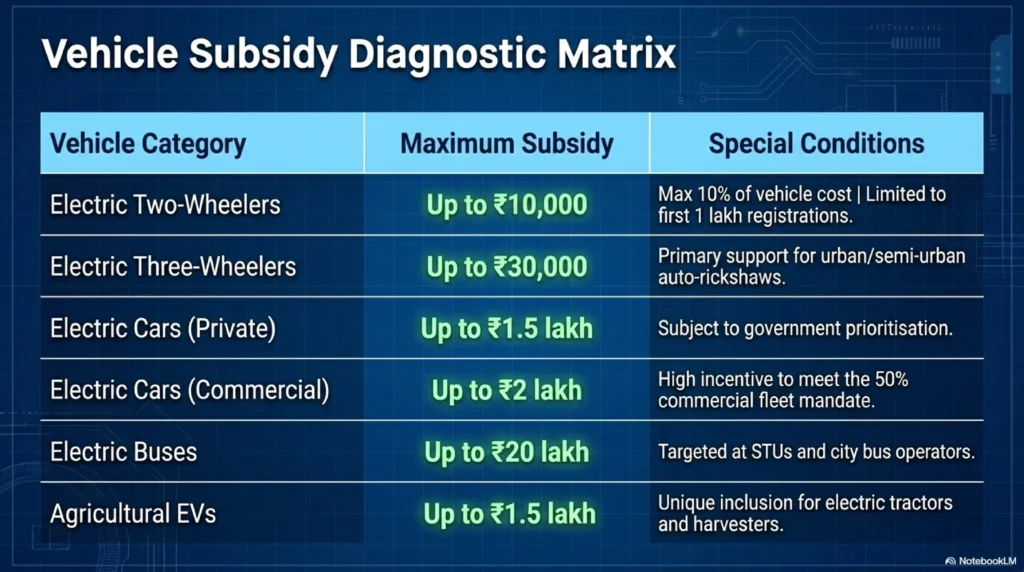
Subsidies are calculated as a percentage of the ex-factory price, subject to a maximum cap. Detailed pictorial representation as well as separate categoty wise subsidies are given below:
Electric Two-Wheelers
- Up to ₹10,000 per vehicle
- Capped at 10% of vehicle cost
- Available for the first 1 lakh eligible registrations
If you are buying an electric scooter for daily city commuting in Pune or Mumbai, this is the most directly relevant benefit.
Electric Three-Wheelers
- Up to ₹30,000 per vehicle
This primarily supports electric auto-rickshaw adoption across urban and semi-urban areas of Maharashtra.
Electric Four-Wheelers
- Commercial EV cars: up to ₹2 lakh per vehicle
- Private EV cars: up to ₹1.5 lakh per vehicle
There are some reports suggesting the government may prioritise commercial EV subsidies over private car incentives. Verify current eligibility directly with the Maharashtra transport department or your dealer before finalising a purchase.
Electric Buses
- Up to ₹20 lakh per bus
Primarily aimed at state transport undertakings and city bus operators transitioning to electric fleets.
Agricultural EVs
- Up to ₹1.5 lakh per electric tractor or harvester
Not many state policies in India specifically include farm machinery. Maharashtra does — a notable inclusion for rural districts.
100% Road Tax and Registration Fee Exemption
All eligible EVs registered during the policy period receive full exemption from:
- Motor vehicle road tax
- Registration fees
For a mid-range electric car priced around ₹15–20 lakh, road tax alone can run into ₹1–1.5 lakh. Getting that waived at the time of purchase is a meaningful saving.
Toll-Free Travel on Major Routes
This is one of the more practical benefits for regular commuters and fleet operators. Eligible EVs get 100% toll waiver on:
- Mumbai-Pune Expressway
- Samruddhi Mahamarg
- Atal Setu (Sewri-Nhava Sheva Atal Setu Bridge)
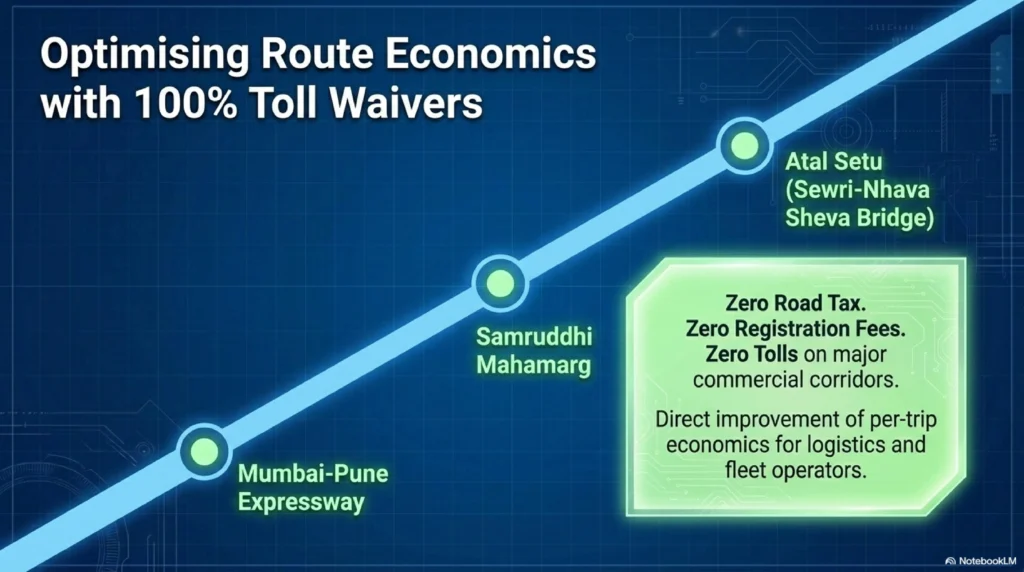
For someone making the Mumbai-Pune run regularly, the toll savings alone add up to thousands of rupees every month. For commercial fleet operators, this directly improves per-trip economics.
Charging Infrastructure — What the Policy Mandates
Range anxiety and charger availability are still the two biggest hesitations among Indian EV buyers. Maharashtra’s policy addresses both with specific mandates.
Fast Chargers on Highways
- One fast charging station every 25 km on all state highways
- The same spacing requirement applies to national highways passing through Maharashtra
This makes long-distance EV travel significantly more practical — whether you are driving from Mumbai to Nashik or Pune to Aurangabad.
Petrol Stations Must Add EV Chargers
Every existing and new petrol station across Maharashtra is expected to install at least one fast charger. This essentially converts the existing fuel retail network into a partial EV charging network — a practical approach that avoids starting from scratch.
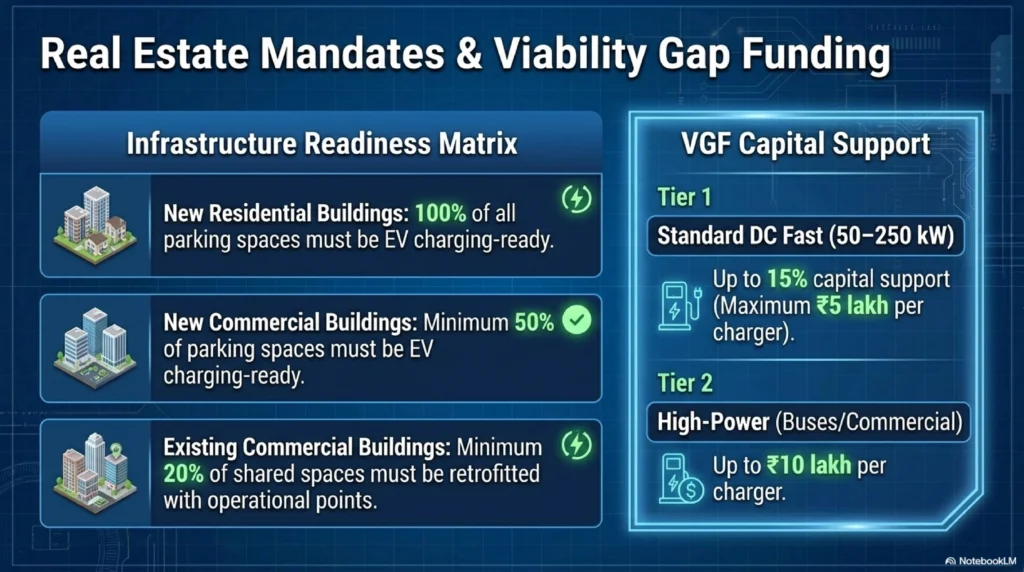
EV Charging Mandates for Buildings
New residential buildings:
- All parking spaces must be EV charging-ready
New commercial buildings:
- Minimum 50% of total parking spaces must be EV charging-ready
Existing commercial buildings:
- At least 20% of shared parking spaces must be retrofitted with operational EV charging points
For apartment buyers in newly approved housing projects, this means EV charging capability will be built in from day one — no retrofitting costs later.
Subsidies for Charging Station Setup
Maharashtra is also offering Viability Gap Funding (VGF) to encourage private investment in charging infrastructure.
Standard DC Fast Chargers (50 kW to 250 kW):
- Up to 15% capital support
- Maximum: ₹5 lakh per charger
High-Power Chargers (for buses, trucks and commercial fleets):
- Up to ₹10 lakh per charger
These subsidies make it more viable for petrol station owners, real estate developers and private operators to invest in charging stations.
Manufacturing Incentives
Maharashtra wants to be an EV manufacturing hub, not just an EV sales market.
Battery packs, cell assembly, motors, power electronics and EV component supply chain units will qualify for D+ category mega project benefits — regardless of which district of Maharashtra they are located in. This is a significant concession, as industrial benefits in Maharashtra are typically location-dependent.
EV Research and Development
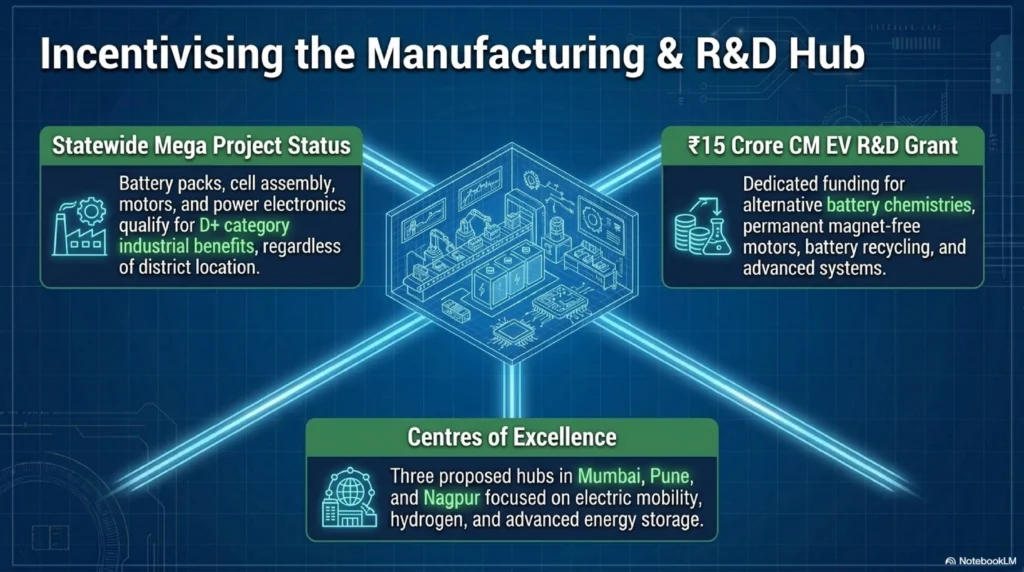
CM EV R&D Grant
A dedicated corpus of ₹15 crore has been established to fund research in:
- Alternative battery chemistries
- Permanent magnet-free motors
- Battery recycling technologies
- Advanced EV systems
Centers of Excellence
The policy proposes at least three Centers of Excellence in educational institutions across Mumbai, Pune and Nagpur — focused on electric mobility, hydrogen mobility, and advanced energy storage.
Government and Commercial Fleet Electrification
All newly procured city-travel vehicles in state government departments are expected to be electric going forward.
For private fleet operators — taxi aggregators, delivery platforms, logistics companies — the policy sets a 50% EV fleet composition target. With toll exemptions and lower running costs, the economics for commercial EV adoption in Maharashtra are becoming more favourable by the year.
Pending Incentives Being Cleared
The Maharashtra government has already approved ₹60 crore to clear backlogs and begin fresh disbursals.
| Purpose | Amount |
| 2021 Policy Backlog | ₹30 crore |
| New 2025 Policy Incentives | ₹26 crore |
| Toll Exemption Reimbursements | ₹4 crore |
Companies already receiving these payouts include Tata Motors, Bajaj Auto, Mahindra Last Mile Mobility and Ather Energy. The fact that payments are actually moving — not just announced — is a positive signal for buyers and businesses considering EV investments in the state.
Who Benefits Most from This Policy?
- Electric scooter buyers using two-wheelers for daily commuting
- Electric auto-rickshaw operators in cities and towns
- Commercial EV fleet owners and logistics companies
- Electric bus operators and STUs
- Charging station investors and real estate developers
- Battery manufacturers and EV component suppliers
- EV startups and research institutions
Private electric car buyers also benefit from road tax savings, registration waivers and toll exemptions — though subsidy eligibility for private cars should be confirmed before purchase.
Read more on what is going on at EV Policy of India at National Level.
Frequently Asked Questions
What is the validity period of the Maharashtra EV Policy 2025?
The policy runs from 1 April 2025 to 31 March 2030.
Are electric vehicles exempt from road tax in Maharashtra?
Yes. All eligible EVs registered during the policy period get 100% exemption from motor vehicle road tax.
Is there any support for setting up EV charging stations in Maharashtra?
Yes. The policy provides Viability Gap Funding of up to ₹5 lakh for standard DC fast chargers and up to ₹10 lakh for high-power chargers serving buses and commercial fleets.