
Petrol prices cross ₹100 per litre in most Indian cities. Servicing costs keep climbing. And yet, a lot of buyers still hesitate before buying an EV — mostly because the real advantages never get explained clearly, without the sales pitch.
This article does exactly that. No hype, no brand promotion — just a plain look at what you actually gain by switching to an electric vehicle in India.
1. Lower Running Cost — The Number That Changes Everything
This is the single biggest reason most Indian buyers are moving to EVs, and the math is hard to argue with.
A typical electric scooter — say an Ather 450X or TVS iQube — costs roughly 15 to 30 paise per kilometre to run, depending on your state’s electricity tariff. A petrol scooter at 45 km/l with petrol at ₹105/litre costs around ₹2.30 per kilometre.
For someone riding 40 km daily for office commuting, that difference adds up to ₹800–₹900 saved every month — just on fuel.
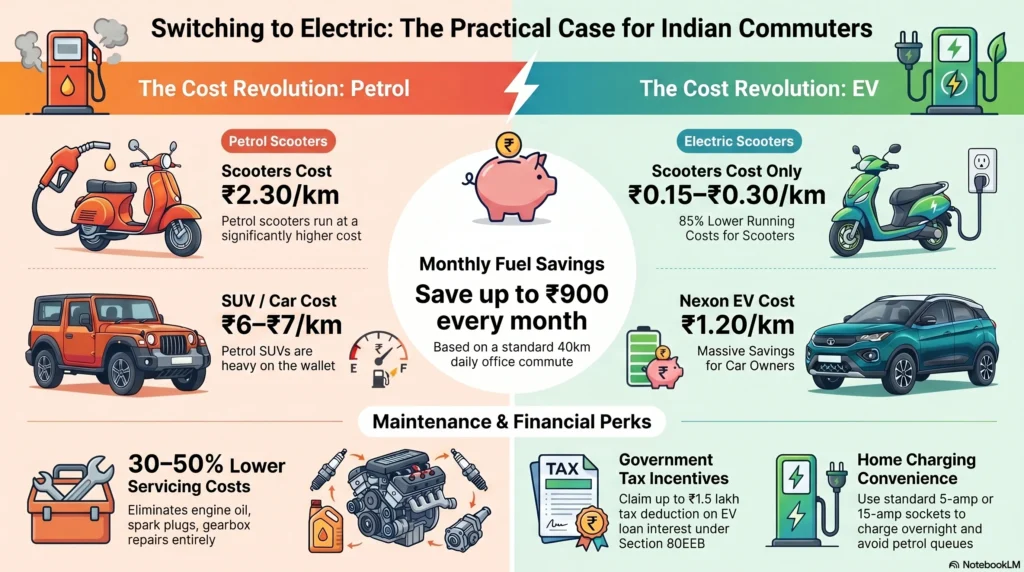
Electric cars follow the same pattern. The Tata Nexon EV costs roughly ₹1.20–₹1.50 per kilometre on electricity versus ₹6–₹7 per kilometre for a comparable petrol SUV.
If you have rooftop solar at home, daytime charging can bring running costs even closer to zero.
2. Lower Maintenance — Fewer Visits to the Service Centre
A petrol vehicle has hundreds of moving parts inside its engine — pistons, valves, timing chains, gearbox components. All of these wear down over time and need periodic attention.
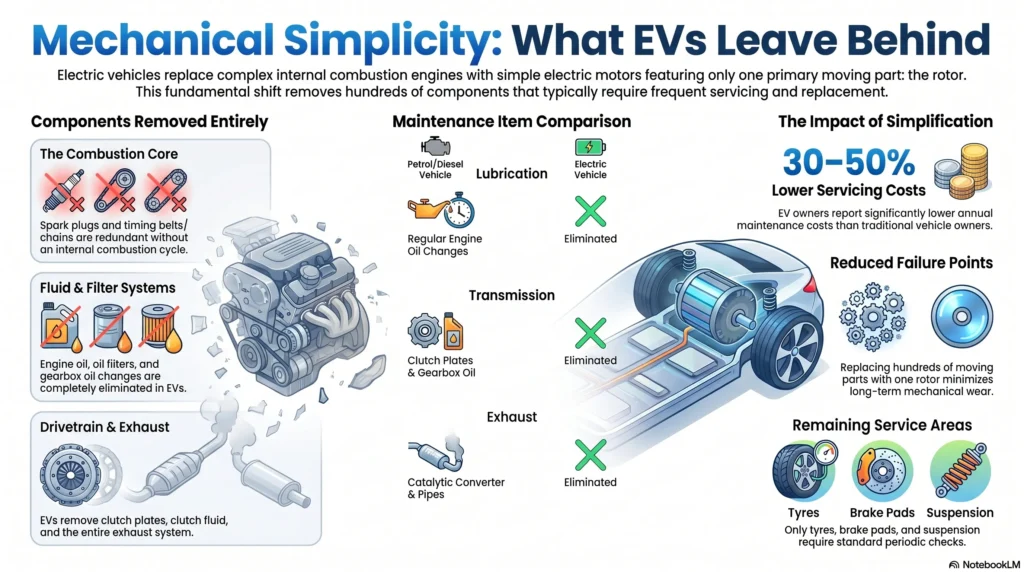
An electric motor has just one primary moving part — the rotor. This is not a simplification; it is the actual mechanical reality.
What EVs eliminate entirely:
- Engine oil and filter changes
- Clutch plates and clutch fluid
- Timing belt or chain replacements
- Spark plugs
- Exhaust system repairs
- Gearbox oil changes
For Indian city riders stuck in heavy traffic daily, this is a significant long-term saving. Most EV owners report annual servicing costs that are 30–50% lower than their old petrol vehicles.
| Maintenance Component | Petrol/Diesel/CNG Vehicle | Electric Vehicle |
|---|---|---|
| Engine Oil & Filters | Required | Eliminated |
| Clutch (Plates & Fluid) | Required | Eliminated |
| Timing Belts & Chains | Required | Eliminated |
| Spark Plugs & Exhaust | Required | Eliminated |
| Tyres, Brakes & Suspension | Needs regular checks | Needs regular checks |
Tyres, brake pads, and suspension still need regular checks — EVs are not maintenance-free, but the reduction is real and noticeable.
3. Instant Torque — Surprisingly Practical in City Traffic
One advantage that EV owners notice immediately but rarely expected beforehand is how the vehicle responds in traffic.
Electric motors deliver maximum torque from zero RPM. There is no need to rev up, no clutch slipping, no waiting for the powerband. You twist the throttle and the vehicle moves — immediately and smoothly.
In Delhi’s ring road traffic or Bengaluru’s stop-and-go signal zones, this makes daily driving noticeably less tiring. Even entry-level electric scooters feel confident and easy to manoeuvre in a way that equivalent petrol scooters do not.
4. Home Charging — The Convenience You Stop Thinking About After One Week
Most people underestimate how much mental energy goes into petrol pump visits — planning when to stop, queuing, carrying change, or using UPI at a pump that sometimes does not cooperate.
EV owners who charge at home simply plug in at night and wake up to a full battery. For electric scooters, a standard 5-amp or 15-amp home socket is enough. For electric cars, a dedicated 32-amp wallbox charger at home gives faster overnight charging.
This works particularly well for:
- Office commuters with fixed daily distances
- Households with covered parking
- Apartment residents where society charging points are available
The convenience is not dramatic — it is quiet and consistent, which is actually better.
5. Zero Tailpipe Emissions — Relevant Beyond Just Environment
EVs produce no exhaust emissions at the point of use. For Indian cities that already struggle with poor air quality — particularly Delhi, Mumbai, and Pune during winter months — this matters.
Beyond environmental benefit, zero tailpipe emissions also means:
- No exhaust heat directed at other riders in traffic
- No carbon buildup inside the vehicle
- Cleaner operation in enclosed spaces like parking basements
India’s electricity grid still uses coal significantly, which means EVs are not completely zero-emission on a lifecycle basis. But the well-to-wheel emissions of an EV in India are still meaningfully lower than a petrol vehicle, and improving as renewable energy share grows.
6. Government Incentives — Check What Your State Offers
The central government’s FAME-II scheme provided direct subsidies on electric two-wheelers and buses. While FAME-II has concluded, PM E-DRIVE has replaced it with continued support for electric two-wheelers, three-wheelers, and buses.
At the state level, benefits vary but commonly include:
- Reduced or waived road tax
- Registration fee waivers
- Direct purchase subsidies (Maharashtra, Delhi, Gujarat, Tamil Nadu, and others have active EV policies)
- Income tax deduction of up to ₹1.5 lakh on interest paid on EV loans under Section 80EEB
Before purchasing, check your state transport department’s current EV policy — these change periodically and the savings can be meaningful.
7. Quieter Driving — Small Detail, Real Difference
Electric motors produce almost no mechanical noise during operation. At city speeds, the only sound is tyre noise and wind.
This is noticeable in two ways. First, the riding experience is calmer — less vibration through the handlebar or seat, no engine drone during long commutes. Second, EVs contribute less to urban noise pollution, which matters in densely populated Indian neighbourhoods.
8. Resale Value Is Stabilising
Early EV buyers in India did face uncertainty around resale value. That situation has improved considerably.
Tata Nexon EV, Ather 450X, and Ola S1 Pro now have established second-hand markets with reasonable resale values. As EV adoption grows and charging infrastructure improves, resale values are expected to stabilise further.
Battery warranty coverage — most manufacturers offer 8 years or 1.6 lakh kilometres — also gives second-hand buyers more confidence.
What EVs Still Cannot Do Perfectly
A fair assessment includes the limitations:
- Public charging infrastructure outside metro cities is still thin
- Long highway trips require charging stop planning
- Battery replacement costs remain high outside warranty periods
- Initial purchase price is higher than comparable petrol vehicles
- Apartments without dedicated parking or charging points create genuine difficulty
For buyers in tier-2 and tier-3 cities without home charging access, the practical case for an EV is weaker right now — though this is changing as public infrastructure expands.
Who Should Seriously Consider Switching to an EV Today
The advantages of electric vehicles are not universal — they depend on your specific usage pattern.
An EV makes strong practical and financial sense if:
- Your daily travel is under 60–70 km
- You have home charging access
- You primarily commute within a city or town
- You want lower monthly operating costs
If your travel pattern fits this description, the financial case for an EV is already solid in India — even before factoring in the quieter ride, lower maintenance, and home charging convenience.
You can read more Guides on EV Basics here.