
Electric vehicles are showing up everywhere now — outside apartment buildings in Bengaluru, at scooter showrooms in Pune, on highways outside Delhi. Yet for every person who has already bought one, there are five more still sitting on the fence with genuine questions.
How does an EV actually work? What happens when the battery dies? Is charging at home really possible? Will it survive Indian summers and flooded roads during monsoon?
These are fair questions, and they deserve straight answers — not brochure language.
This guide covers EV basics from the ground up. If you are buying your first electric scooter or considering an electric car, this is the only starting point you need.
What Exactly Is an Electric Vehicle?
An electric vehicle is any vehicle that uses an electric motor as its primary source of power, drawing energy from a rechargeable battery pack instead of burning petrol or diesel.
When you press the accelerator, electricity flows from the battery to the motor, which rotates the wheels. That is the entire core mechanism — no combustion, no exhaust gases, no fuel tank.
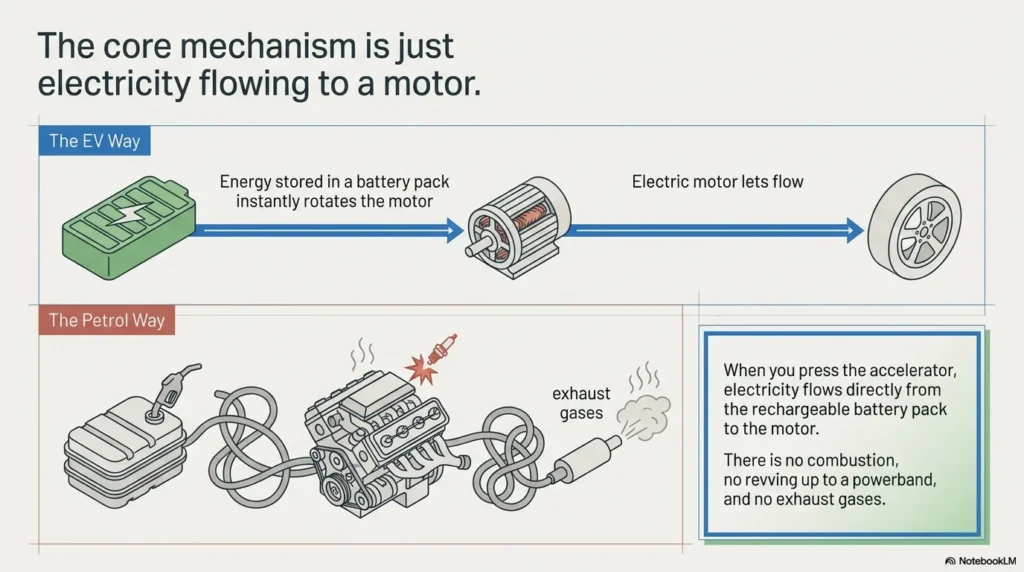
Because there is no internal combustion engine, EVs do not need several components like Engine Oil & filters, Clutch system, Exhaust Pipe, Catalytic converter, Fuel tank, Tradiatinal Gearbox etc. that petrol vehicles require:
This mechanical simplicity is one reason why EVs have lower maintenance costs over time — but it does not mean zero maintenance. More on that later.
In India, electric vehicles are currently available across these segments:
- Electric scooters (most popular segment by volume)
- Electric motorcycles
- Electric cars
- Electric three-wheelers and auto-rickshaws
- Electric buses
Electric scooters dominate right now because they suit India’s urban commuting pattern — short daily distances, heavy city traffic, and fixed parking at home where overnight charging is practical.
Types of Electric Vehicles Available in India
Battery Electric Vehicles (BEV)
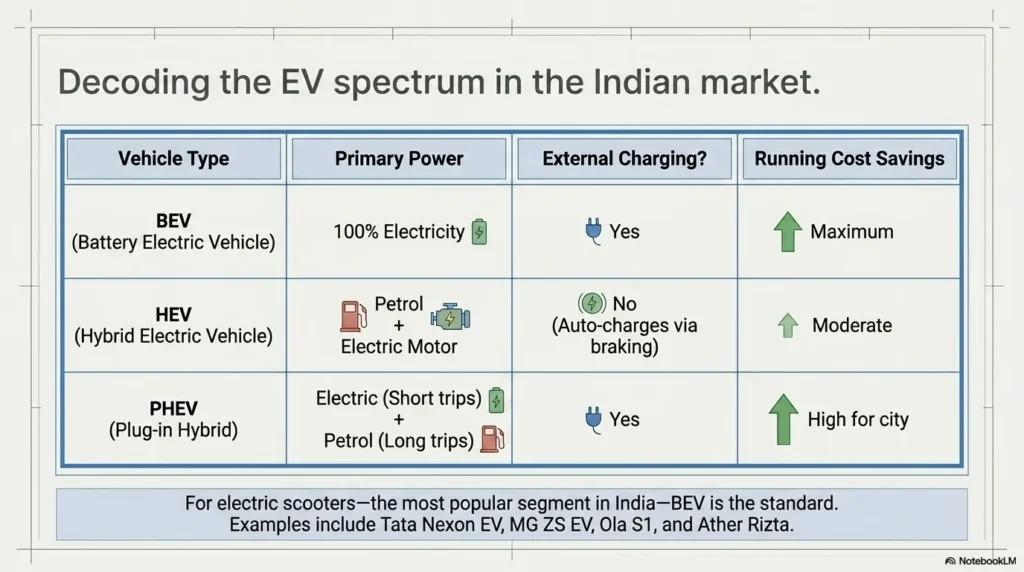
These are fully electric vehicles. They run only on electricity and need to be charged through a charging point — either at home or at a public station.
Popular BEVs in India include:
If you are looking at an EV in India today, this is the category you will most likely be choosing from.
Hybrid Electric Vehicles (HEV)
Hybrid vehicles use both a petrol engine and an electric motor working together. The battery charges automatically through regenerative braking and engine operation — no external charging needed.
Hybrids are useful for buyers who want better fuel efficiency but are not ready to depend on charging infrastructure. The Maruti Suzuki Grand Vitara with strong hybrid and the Toyota Hyryder are examples available in India.
Plug-in Hybrid Electric Vehicles (PHEV)
PHEVs carry a larger battery than regular hybrids and can be charged externally. They can run short distances on electricity alone and then switch to petrol for longer trips.
This segment is limited in India currently, though it is a practical middle ground for buyers who do long highway trips regularly but want electric running costs for city use.
Main Components Inside an EV — Explained Simply
The Battery Pack
The battery pack is the energy storage unit of the vehicle. Think of it as the fuel tank, except it stores electrical energy instead of petrol.
Most modern EVs use lithium-ion batteries because they offer a good combination of energy density, charge cycles, and weight.
Battery capacity is measured in kilowatt-hours (kWh). As a rough guide:
- Electric scooters typically carry 2 kWh to 4 kWh
- Entry-level electric cars like the Tata Tiago EV carry around 19–24 kWh
- Larger electric cars like the Tata Nexon EV carry around 30–40 kWh
Higher capacity generally means more driving range, but it also means longer charging time and higher vehicle cost.
Battery health degrades slightly over years of use — similar to how a smartphone battery holds less charge after two or three years. However, automotive-grade EV batteries are designed for much longer life than phone batteries, and most manufacturers offer battery warranties of 8 years or 1.6 lakh kilometres.
The Electric Motor
The electric motor converts electrical energy into mechanical motion. It is what actually moves the vehicle.
Electric motors deliver torque instantly from zero RPM — unlike petrol engines which need to build up revs before producing full power. This is why even a modest electric scooter feels quick to pull away from a traffic signal.
Electric motors are also significantly quieter than petrol engines, which changes the driving experience noticeably.
The Controller (Power Electronics Unit)
The controller manages how much electricity flows from the battery to the motor at any given moment. When you twist the throttle more, the controller increases power delivery. When you brake, it can reverse that process for regenerative braking.
This is the system that translates your inputs into actual vehicle behaviour.
The On-Board Charger
When you plug your EV into a power source, the on-board charger converts AC electricity from the grid into DC electricity that the battery can store. The capacity of this charger (measured in kW) directly affects how fast your vehicle charges on a standard outlet.
Different EVs have different on-board charger capacities, which is why two vehicles plugged into the same charging point can charge at different speeds.
Regenerative Braking System
Regenerative braking is a system that captures energy during deceleration and converts it back into electricity to partially recharge the battery.
In heavy stop-and-go Indian city traffic, regenerative braking can meaningfully extend real-world range because you are braking and decelerating constantly throughout the commute.
How EV Charging Works in India
Charging is the part that confuses most first-time EV buyers. Here is how it actually works.
Level 1 — Standard Home Charging (AC Slow Charging)
This uses a regular 15-amp household socket. For electric scooters, this is the most common and practical charging method.
You plug the scooter in overnight, and it is fully charged by morning. For most electric scooters, a full charge on a standard socket takes 4 to 6 hours.
For electric cars, a standard socket is slower — a Tata Nexon EV on a 15A socket can take 15 hours or more for a full charge, which is why many car owners install a dedicated home charging unit.
Level 2 — AC Fast Charging (Home Wallbox or Public AC Charger)
A dedicated AC wallbox charger (also called a home charging station) plugs into a 32-amp outlet and charges significantly faster than a standard socket.
For electric cars, this is the recommended home charging setup. Most new EV car buyers get a wallbox installed as part of their purchase.
Public AC chargers at malls, offices, and parking facilities work on the same principle.
Level 3 — DC Fast Charging (Public Fast Chargers)
DC fast chargers bypass the vehicle’s on-board charger and feed electricity directly into the battery at very high power levels — often 30 kW to 60 kW or more.
This can charge an electric car battery from 20% to 80% in 45 to 60 minutes in many cases.
DC fast chargers are being installed across Indian highways through networks like Tata Power, EESL, ChargePoint, and individual brand networks from Tata, MG, and Ather.
Important: Not all vehicles support DC fast charging. Check your specific vehicle’s compatibility before expecting fast charging speeds at a public station.
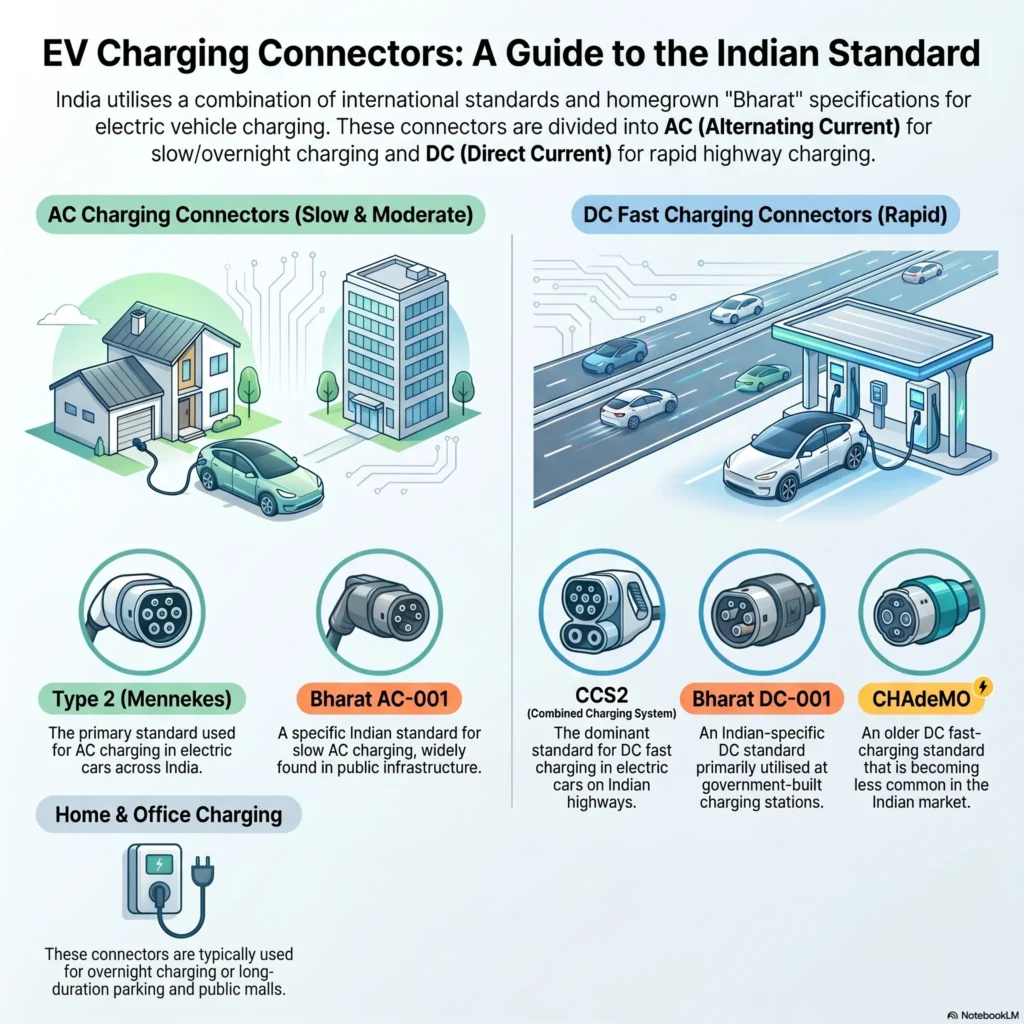
Charging Connectors Used in India
| Connector Type | Charging Level | Use Case & Status in India |
|---|---|---|
| Type 2 (Mennekes) | AC Charging | The standard connector for AC charging in electric cars. |
| CCS2 | DC Fast Charging | The standard connector for DC fast charging in electric cars. |
| CHAdeMO | DC Fast Charging | An older DC fast charging standard that is less common now. |
| Bharat AC-001 | AC Slow Charging | The Indian standard for AC slow charging, commonly found in public infrastructure. |
| Bharat DC-001 | DC Charging | The Indian standard for DC charging, frequently used in government-built stations. |
| Proprietary | Varies | Most electric scooter brands use their own specific charger that comes with the vehicle. |
For electric scooters, most brands use a proprietary charger that comes with the vehicle.
Understanding EV Range — What the Numbers Actually Mean
Range is the distance an EV can travel on a single full charge. It is the number every buyer looks at first, and it is also the number that causes the most confusion.
Certified Range vs. Real-World Range
EV range figures in India are tested under the ARAI (Automotive Research Association of India) cycle, which is a controlled lab test. Real-world range is almost always lower.
Factors that reduce range in actual Indian conditions:
- City stop-and-go traffic (though regenerative braking helps partially offset this)
- High speeds on highways — range drops sharply above 70–80 km/h
- Air conditioning use — can reduce range by 15–25% in Indian summer heat
- Carrying pillion rider or luggage
- Tyre pressure — under-inflated tyres increase energy consumption
- Battery temperature — extreme heat during Indian summers affects efficiency
- Battery age — capacity reduces slightly over years of use
As a practical thumb rule, expect 70–80% of the ARAI-certified range in everyday Indian conditions.
Is Range Anxiety a Real Concern?
For most Indian urban commuters, no. The average daily commute in Indian cities is under 30–40 km. Most electric scooters offer 80–120 km of real-world range, which comfortably covers this.
Range anxiety is more relevant for highway travel and long intercity trips, where charging infrastructure still has gaps in many corridors.
EV Running Cost in India — The Real Numbers
Lower running cost is the most tangible financial benefit of switching to an EV.
Electricity Cost per Kilometre
To calculate charging cost, you will need following parametres:
- Battery capacity (kWh)
- Real-world range (km)
- Electricity tariff in your state (₹ per unit)
Don’t get confused!! Let’s calculate it for an Electric Scooter against a Petrol Scooter making some assumptions:
| Parameter | Electric Scooter (EV) | Petrol Scooter |
|---|---|---|
| Energy/Fuel Capacity | 3 kWh Battery | 1 Litre Petrol |
| Real-World Range / Mileage | 90 km per charge | 45 km per litre |
| Energy/Fuel Rate | ₹7 per unit | ₹110 per litre |
| Cost per Charge / Litre | ₹21 | ₹110 |
| Running Cost per Kilometre | ₹0.23 | ₹2.44 |
A comparable petrol scooter at 45 km/l with petrol at ₹110/litre costs approximately ₹2.44 per km. The difference is significant, especially if you ride 30–40 km daily for office commuting.
We can have whole separate discussion on different fuel types against an EV like:
Use our “EV Savings Calculator” and “EV Charging Cost Calculator” for more clarity
Factors That Affect Actual Running Cost
- Home charging is cheaper than commercial charging stations
- Electricity tariff slabs differ across states — check your state’s domestic tariff
- Night charging on some state electricity boards attracts lower tariffs
- AC usage adds to electricity consumption
Advantages of Owning an EV in India
Lower Running Cost for Daily Commuting
As shown above, the per-km cost of an EV is significantly lower than a petrol vehicle for city commuting. Over 3–5 years, this saving becomes substantial.
Reduced Mechanical Maintenance
No engine oil changes, no air filter for the engine, no spark plugs, no timing belt. Electric motors have far fewer moving parts than petrol engines.
Servicing costs for EVs are generally lower, though software updates, tyre replacements, and brake servicing are still required.
Smooth, Quiet Ride
Electric motors produce minimal vibration and noise. In heavy city traffic, this makes a noticeable difference to rider fatigue.
Instant Torque Delivery
EVs respond immediately to throttle input. There is no revving up to the powerband. This makes them practical and confidence-inspiring in dense city traffic.
Government Subsidies and Incentives
Several state governments in India offer subsidies on EV purchase, registration fee waivers, and road tax exemptions. The central FAME-II scheme has supported electric two-wheeler and bus adoption. Check your state transport department for current applicable benefits before purchase.
Meanwhile Detailed guide on Advantages of EVs is available here.
Disadvantages and Honest Limitations
Higher Purchase Price
EVs generally cost more upfront than equivalent petrol vehicles. The battery pack is expensive, and this cost is passed on to the buyer. Running cost savings offset this over time, but the initial outlay is higher.
Charging Time vs. Refuelling Time
Filling petrol takes 3–5 minutes. Even DC fast charging an EV to 80% takes 45–60 minutes at minimum. For home charging overnight, this is not a problem. For highway trips, this requires planning.
Public Charging Infrastructure — Still Developing
India’s public charging network is growing, but coverage outside metro cities remains uneven. For buyers in tier-2 and tier-3 cities, relying on public charging is not yet practical as a primary strategy. Home charging remains essential.
Battery Replacement Cost
EV batteries do degrade over time and will eventually need replacement. Replacement costs vary by brand and battery size but can run into several lakhs for larger car battery packs. Most manufacturers offer 8-year warranties, but buyers should factor this into the long-term ownership calculation.
Monsoon and Flood Considerations
Modern EVs are built with IP-rated protection for their battery packs and electrical systems. Established brands like Tata, Ather, and Bajaj have put their vehicles through Indian monsoon conditions. However, driving through severely flooded roads — the kind where petrol vehicles also stall — is not advisable for any EV. Common sense applies.
You can read full guide on Disadvantages of EVs here.
Are EVs Practical for Indian Buyers Right Now?
The honest answer: it depends on your specific situation.
EVs make clear practical sense if:
- Your daily commute is under 60–70 km
- You have fixed parking where overnight home charging is possible
- You primarily drive within a city or town
- You want lower monthly fuel and maintenance spending
EVs are more challenging if:
- You live in an area with unreliable electricity supply
- You have no fixed parking (common in older urban areas)
- You regularly need to travel long intercity distances without advance planning
- You need a vehicle that multiple family members will use with unpredictable schedules
Electric scooters currently offer the best practical case for the majority of Indian buyers. Electric cars are practical in metros and larger cities where home charging and expanding public infrastructure work together.
Common EV Myths — Addressed
“EV batteries fail within 2–3 years”
Not exactly! Because this comes from comparing phone batteries to EV batteries. They are not the same. Automotive-grade lithium-ion battery packs are engineered for 8–10 years of regular use. Most manufacturers back this with warranty. Proper charging habits — avoiding frequent 100% charges and deep discharges — extend battery life further.
“EVs cannot handle Indian heat and monsoon”
This is another myth. Ather, Tata, TVS, Bajaj — these vehicles have been operating in Rajasthan summers and Kerala monsoons for years. IP67-rated battery enclosures and thermal management systems exist specifically for these conditions.
“Only wealthy buyers can afford EVs”
Electric scooters start under ₹1 lakh in some segments after state subsidies. The Tata Tiago EV brought electric cars below ₹10 lakh. The price gap with petrol vehicles is narrowing.
“EVs have zero maintenance”
Incorrect. EVs still need:
- Tyre rotations and replacements
- Brake pad inspections (though regenerative braking reduces wear)
- Suspension checks
- Software updates
- Coolant system maintenance (in some vehicles)
The difference is that engine-related maintenance is eliminated — not all maintenance.
“Charging at home will spike my electricity bill drastically”
A 3 kWh scooter battery charged daily consumes 3 units of electricity. At ₹7/unit, that is ₹21/day or approximately ₹630/month. This is far less than petrol costs for the same distance.
Future of EVs in India — What to Realistically Expect
India’s EV market is growing steadily. Electric two-wheelers are leading the growth, driven by daily commuting economics. Electric three-wheelers in commercial use are also expanding rapidly.
For electric cars, adoption will accelerate as:
- Battery prices continue declining globally
- More affordable models enter the market
- Highway charging corridors develop further
- Apartment society charging infrastructure becomes standard
Battery technology is also evolving — solid-state batteries, better thermal management, and faster charging are all in development across global manufacturers, and India will see the benefits as these mature.
The shift will not happen overnight, and petrol vehicles will remain dominant for several more years. But for urban commuters who do the numbers honestly, switching to an EV already makes financial sense today.
Frequently Asked Questions
What is the difference between a BEV and a hybrid?
A BEV (Battery Electric Vehicle) runs only on electricity and must be externally charged. A hybrid uses both a petrol engine and an electric motor, with the battery charging automatically — no plug required.
Can I charge an EV using a regular home socket in India?
Yes. Most electric scooters come with a portable charger that plugs into a standard 5-amp or 15-amp socket. Electric car owners typically install a dedicated 32-amp wallbox for faster charging.
How long does an EV battery last in India?
With normal usage and reasonable charging habits, modern EV batteries are designed to last 8–10 years before meaningful capacity degradation. Most manufacturers provide an 8-year/1.6 lakh km battery warranty.
What happens to the EV battery in extreme summer heat?
Thermal management systems in modern EVs control battery temperature. You may notice slightly reduced range on very hot days, but well-engineered EVs handle Indian summer conditions. Parking in shade when possible and avoiding frequent fast charging in peak heat helps battery longevity.
Is it safe to charge an EV during monsoon?
Yes, if you are using the manufacturer-supplied charger and a proper earthed socket. EV charging systems are designed with moisture protection. Avoid charging outdoors in heavy rain without appropriate shelter for the charging socket.
Are government subsidies still available in India?
Subsidies vary by state and change periodically. Check your state transport department website or consult the showroom at time of purchase for current applicable benefits.
Before You Buy — A Practical Checklist
Before deciding on an EV purchase, run through these honestly:
- Daily commute distance and whether it fits within real-world range
- Parking situation — do you have a fixed spot for home charging?
- Nearest public charging station to your home and workplace
- State electricity tariff and whether night charging is cheaper
- Total cost of ownership comparison including insurance, maintenance, and battery warranty
- Service centre availability for your chosen EV brand in your city
An EV bought after thinking through these points will serve you well. One bought on marketing hype alone may disappoint.
Written by ParthK, Electronics and Communication Engineer. Published on ev-guide.in under EV Guides > EV Basics.
Read More detailed EV Guides below:
- EV Basics Explained: Everything a First-Time EV Buyer in India Actually Needs to Know
- Advantages of Electric Vehicles in India That Actually Matter for Daily Use
- Disadvantages of Electric Vehicles in India — The Honest Picture Before You Buy
- EV vs Petrol Car in India 2026: Which One Actually Saves You More Money?
- EV vs Diesel Car in India 2026: Running Costs, Highway Reality & the Honest Verdict