
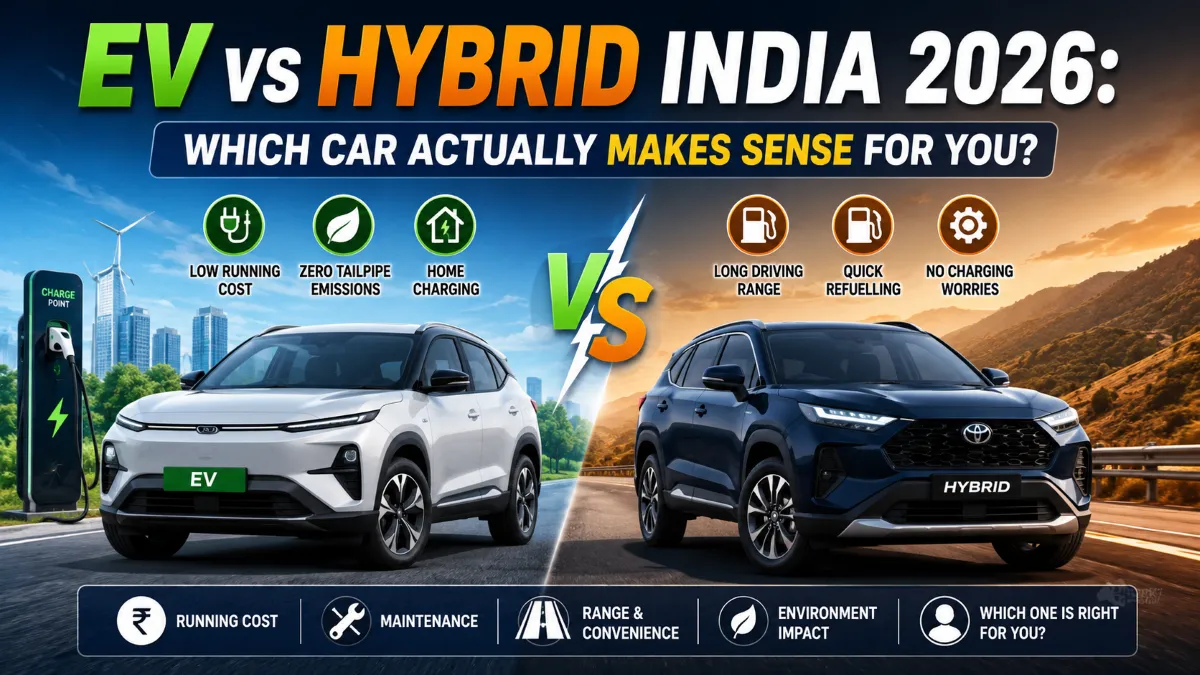
Planning to buy a new car in 2026 and stuck in EV vs hybrid battle? You are not alone. This is genuinely one of the more important decisions an Indian car buyer faces right now.
Electric vehicles are showing up more and more on Indian roads — from Tata’s lineup to Mahindra’s new BE series. At the same time, strong hybrids from Toyota and Maruti Suzuki are pulling in buyers who want better mileage without worrying about charging points. Both promise lower fuel bills and cleaner driving compared to a regular petrol or diesel car, but they work in very different ways and suit very different lifestyles.
This comparison looks at both technologies through the lens of real Indian conditions — city traffic, highway runs, monsoon flooding, apartment parking, and everything in between.
EV vs Hybrid at a Glance
Here is at a glance comaprison table for both EV and the hybrid version:
| Feature | Electric Vehicle (EV) | Hybrid Vehicle |
|---|---|---|
| Power Source | Battery and electric motor only | Petrol engine + electric motor |
| Refuelling | Requires charging | Standard petrol pump |
| Running Cost | Lowest | Lower than petrol, higher than EV |
| Maintenance | Very low | Moderate |
| Tailpipe Emissions | Zero | Reduced, not zero |
| Long-Distance Travel | Depends on charging network | Very convenient |
| Driving Feel | Silent, instant pull | Similar to petrol |
| Home Charging Needed | Recommended | Not required |
| Best For | City commuters | Mixed city and highway users |
What Is an Electric Vehicle?
An EV runs entirely on electricity stored in a battery pack. There is no petrol engine, no exhaust pipe, and no trip to the petrol station.
Well-known EVs available in India right now:
- Tata Nexon EV
- Tata Curvv EV
- MG Windsor EV
- MG ZS EV
- Mahindra BE 6
- BYD Atto 3
Because an electric motor delivers torque instantly, EVs feel quick and responsive in stop-and-go city traffic. And with fewer moving parts than a petrol engine, there is simply less to go wrong over time.
What EVs do well
- Lowest running cost per kilometre
- Zero tailpipe emissions
- Quiet, refined driving experience
- Significantly lower maintenance bills
- Charge overnight at home like a smartphone
- FAME-II and state-level subsidies bring purchase costs down
Where EVs fall short
- Higher upfront cost in certain segments
- Charging infrastructure is still patchy outside metros and major highways
- A full charge takes longer than a five-minute petrol fill
- Long trips require some planning around charging stops
What Is a Hybrid Vehicle?
A hybrid combines a petrol engine with an electric motor. The car’s system decides automatically which power source to use — or both together — depending on speed, load, and driving conditions. You never plug it in (for most hybrids), and you never have to think about range anxiety.
Popular hybrids in India:
- Toyota Hyryder Strong Hybrid
- Maruti Suzuki Grand Vitara Strong Hybrid
- Toyota Innova Hycross Hybrid
- Honda City e:HEV
The three types of hybrids
Mild Hybrid The electric motor gives a small assist to the petrol engine but cannot drive the car on its own. You get a marginal improvement in fuel efficiency, not a dramatic one. Examples: Maruti Brezza, Hyundai Venue
Strong Hybrid This is the real deal. The car can run on electric power alone at lower speeds, and the petrol engine takes over or assists on highways. Fuel efficiency gains are significant — often 20–30% better than a comparable petrol-only car. Examples: Toyota Hyryder, Maruti Grand Vitara Hybrid
Plug-in Hybrid (PHEV) Can be charged from an external socket and offers a meaningful electric-only range before switching to petrol. Very popular in Europe but PHEVs are still rare in the Indian market as of 2026.
What hybrids do well
- No charging dependency whatsoever
- Excellent fuel efficiency, especially in city traffic
- Refuel anywhere in India in under five minutes
- Comfortable on long highway runs
- Familiar ownership experience for someone moving from a petrol car
Where hybrids fall short
- Still consume petrol — not emission-free
- More complex mechanically than either a pure EV or a pure petrol car
- Maintenance costs are higher than an EV
- Cannot eliminate fuel expenses entirely
Running Costs: EV vs Hybrid
This is where EVs pull well ahead in most cases.
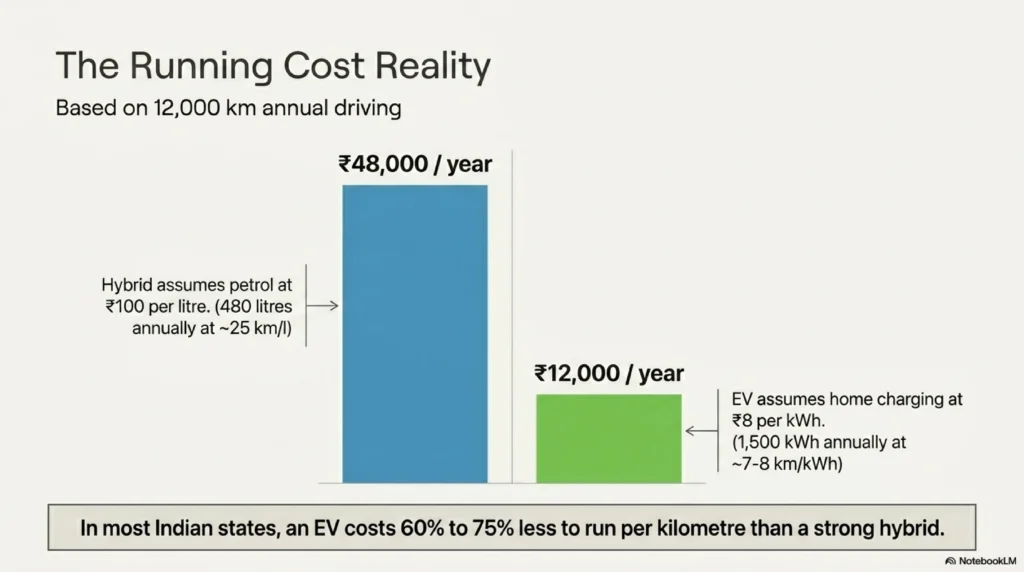
Assumptions used:
- Petrol price: ₹100 per litre
- Home charging rate: ₹8 per kWh
- Annual driving: 12,000 km
Strong Hybrid A strong hybrid delivering around 25 km/l will consume roughly 480 litres of petrol per year. Annual fuel cost: ₹48,000
EV An EV averaging 7–8 km/kWh will use approximately 1,500–1,700 kWh per year. Annual charging cost: ₹12,000–₹13,600
In most Indian states, the annual running cost of an EV works out to roughly 60–75% less than a strong hybrid. Over five years, that gap becomes significant.
Maintenance Costs: EV vs Hybrid
This is another area where EVs have a clear structural advantage. An electric drivetrain eliminates several components that need regular servicing in a petrol or hybrid car:
- No engine oil or oil filter changes
- No spark plugs
- No clutch (in most EVs)
- No exhaust system
- No fuel injectors or fuel filter
Approximate 5-year maintenance cost comparison:
| Vehicle Type | Estimated 5-Year Cost |
|---|---|
| EV | ₹2,000 – ₹15,000 |
| Strong Hybrid | ₹15,000 – ₹35,000 |
The difference becomes more pronounced after 3–4 years of ownership when a hybrid’s engine-related service intervals start adding up.
Range: EV vs Hybrid
Range is still the most common reason buyers hesitate on EVs.
| Vehicle Type | Real-World Range |
|---|---|
| EV | 250–500 km per charge |
| Strong Hybrid | 800–1,200 km per tank |
A strong hybrid can comfortably cover the distance from, say, Bhopal to Nagpur and back without a second thought. For an EV on the same route, you would want to confirm charger availability along the way — though infrastructure on NH-44 and other major corridors has improved noticeably.
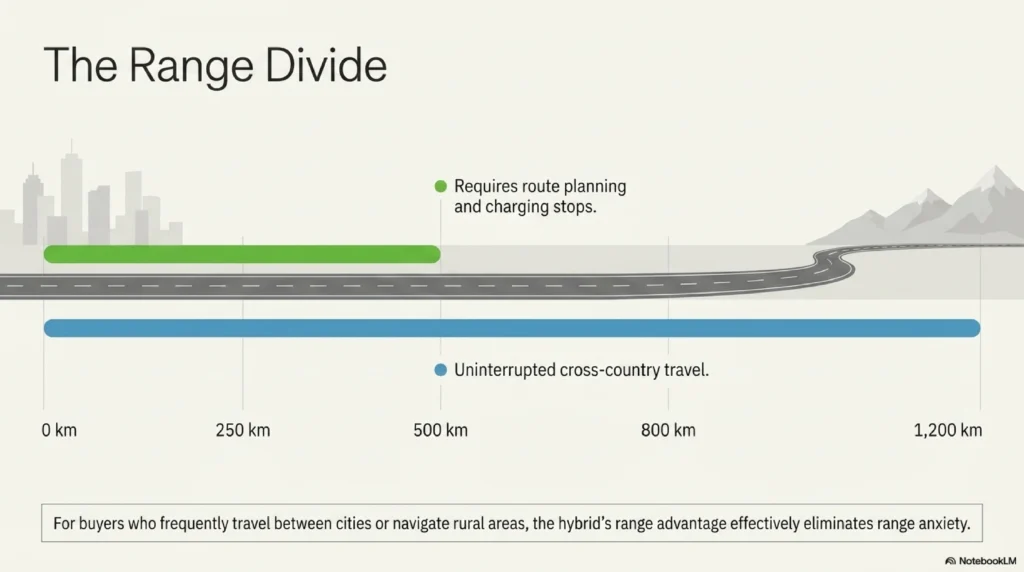
For daily city commutes of 40–80 km, most EVs handle this easily on a single overnight charge.
Charging and Infrastructure: Where Does India Stand in 2026?
India’s public charging network has expanded considerably, particularly along major national highways and in Tier-1 cities. However, the experience is still uneven.
An EV works well for you if:
- You have a dedicated parking spot at home or in your building
- You can get a 7.2 kW AC home charger installed
- Your daily driving stays within 150–200 km
- You live or work in a city with reasonable public charging coverage
A hybrid works better for you if:
- You live in an apartment complex with no charging access
- You regularly drive between cities or to smaller towns
- Your route includes rural areas where DC fast chargers are absent
- You want the security of a petrol station being 500 metres away
Environmental Impact
Both are cleaner than a conventional petrol or diesel vehicle. But the gap between them is meaningful.
EVs:
- Zero tailpipe emissions
- Lower lifecycle emissions even accounting for India’s coal-heavy power grid
- Better contribution to cleaner urban air quality
- Reduce dependence on imported crude oil
Strong Hybrids:
- Meaningfully lower emissions than pure petrol cars
- Still burn fossil fuel and emit CO₂
- An improvement over petrol, but not a zero-emission option
If reducing your environmental footprint is a priority, an EV is the more effective choice in the long run.
Total Cost of Ownership: Which Wins?
A hybrid typically has a lower purchase price in the same segment. But EVs often close that gap through savings on fuel and servicing.
EVs generally win the cost calculation if:
- Annual driving exceeds 15,000 km
- Home charging is available
- You plan to own the vehicle for more than five years
Hybrids generally win if:
- Annual driving is below 8,000 km
- Long-distance interstate travel is frequent
- Charging access at home is not possible
EV vs Hybrid: the ultimate comaprison matrix
Here is pictorial representation of the comaprison matrix between the two:
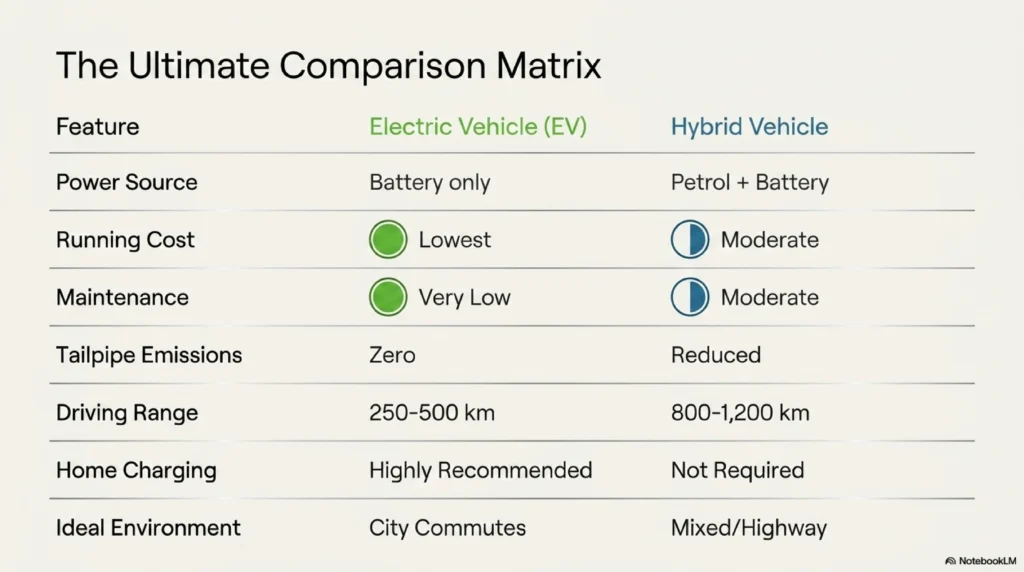
Clearly the decision of choosing between EV vs hybrid boild down to some individual key matrix. See where your personal and financial situation fits in on above comaprison matrix and then decide:
Who Should Buy an EV?
An EV makes strong financial and practical sense if:
- Most of your driving is within city limits
- You have a parking spot where you can charge overnight
- You want the lowest possible running cost
- You plan to own the car for five years or more
- You want a quiet, modern driving experience with instant response in traffic
Who Should Buy a Hybrid?
A strong hybrid is the smarter choice if:
- You regularly drive on highways or make long inter-city trips
- Public and home charging is not accessible
- You want better fuel efficiency without adjusting how you drive
- You are not yet comfortable depending on a charging network
- You want the simplicity of stopping at any petrol pump in the country
EV vs Hybrid India: The Honest Answer
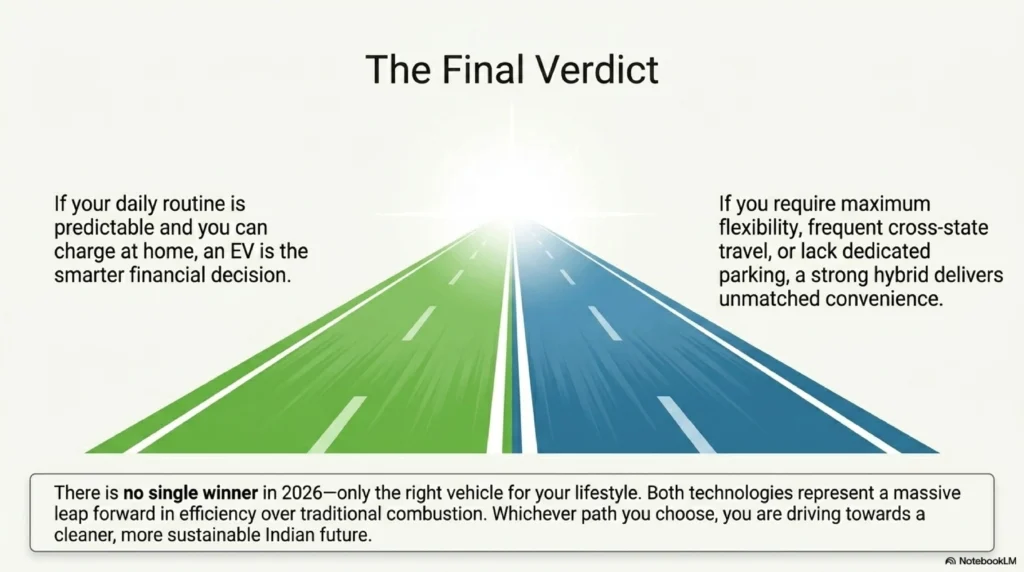
There is no universal winner here — the right answer depends almost entirely on how and where you drive.
For urban families and daily commuters with home charging access, an EV consistently delivers lower ownership costs and the better long-term proposition. For buyers who regularly travel across states, drive through areas where charging infrastructure is still thin, or simply cannot install a home charger, a strong hybrid is the more practical and flexible option.
What has changed in 2026 is that the EV case is stronger than it was two years ago. Charging infrastructure on major corridors has improved, more affordable EV options have entered the market, and battery technology has moved on. But the hybrid is not obsolete by any measure — it remains a genuinely sensible choice for a large segment of Indian buyers.
However the first time EV buyers may still be confused on several factors; Here is a full EV Guide for first time buyers for more help.
Frequently Asked Questions
Is an EV cheaper to run than a hybrid in India?
Yes, by a significant margin. Electricity costs far less than petrol on a per-kilometre basis. Most EV owners in India spend roughly ₹1–1.5 per km, compared to ₹4–5 per km for a strong hybrid.
Do hybrid cars in India need to be charged?
Most strong hybrids; like the Toyota Hyryder and Maruti Grand Vitara Hybrid — do not require external charging. The battery is recharged automatically through regenerative braking and the petrol engine.
Are hybrids better for long road trips in India?
Generally, yes. A hybrid can be refuelled at any petrol station across India in minutes, and delivers a range of 800–1,200 km per tank. EV range and charger availability on certain routes still require planning.