
Every EV advertisement you will see; It will just pitch on “the savings”. Lower running cost, no engine noise, home charging convenience — all of that is real. But is it really so? because the limitations or disadvantages of EVs rarely get the same spotlight.
If you are seriously considering buying an electric vehicle in India, you should also be understanding the disadvantages of it — it is just practical sense. Some of these are temporary problems tied to a developing ecosystem. Others are fundamental trade-offs you will live with for years.
Here is the honest picture to help you.
Higher Purchase Price — Still the Biggest Barrier
Walk into any showroom today and compare an EV to its petrol equivalent. The EV will cost more — often several lakhs more — for a similar size and feature set.
The primary reason is the lithium-ion battery pack, which remains expensive to manufacture. This cost is passed directly to the buyer.
This hits hardest for:
- Middle-class families buying their first car on a loan
- Buyers in small towns with limited yearly driving
- Users where the running cost savings will take too many years to recover the premium
Government subsidies and state incentives help at the margins. The PM E-DRIVE scheme and various state EV policies reduce the upfront cost somewhat. But for a large section of Indian buyers, the purchase price remains a genuine obstacle — not just a minor inconvenience.
Here is a worked out “Break-Even Calculation” illustrated.
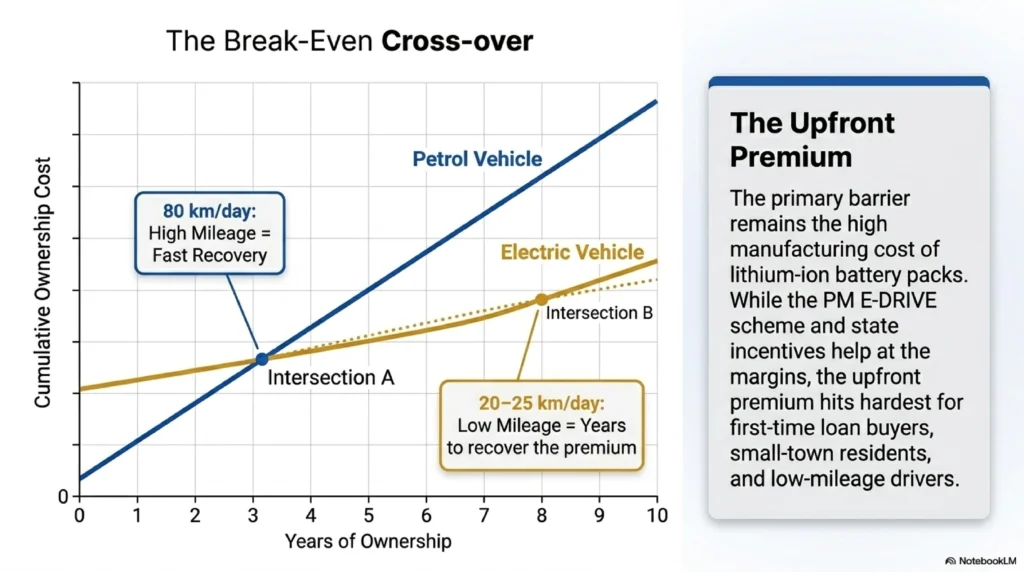
The break-even calculation depends heavily on how much you drive. If your daily commute is 20–25 km, the running cost savings take years to recover the price premium. If you ride 60–80 km daily, the math works faster.
Charging Infrastructure — Improving, But Still Patchy
Public charging in metro cities has improved noticeably. Tata Power, Ather Grid, ChargePoint, and EESL stations are visible in Bengaluru, Delhi, Mumbai, Pune, and Hyderabad. Malls, office complexes, and some petrol pumps now carry charging points.
Step outside these cities, and the picture changes.
On national highways, some charging stations are appearing but gaps remain. In tier-2 and tier-3 cities, public charging is still thin. Rural areas are largely uncovered.
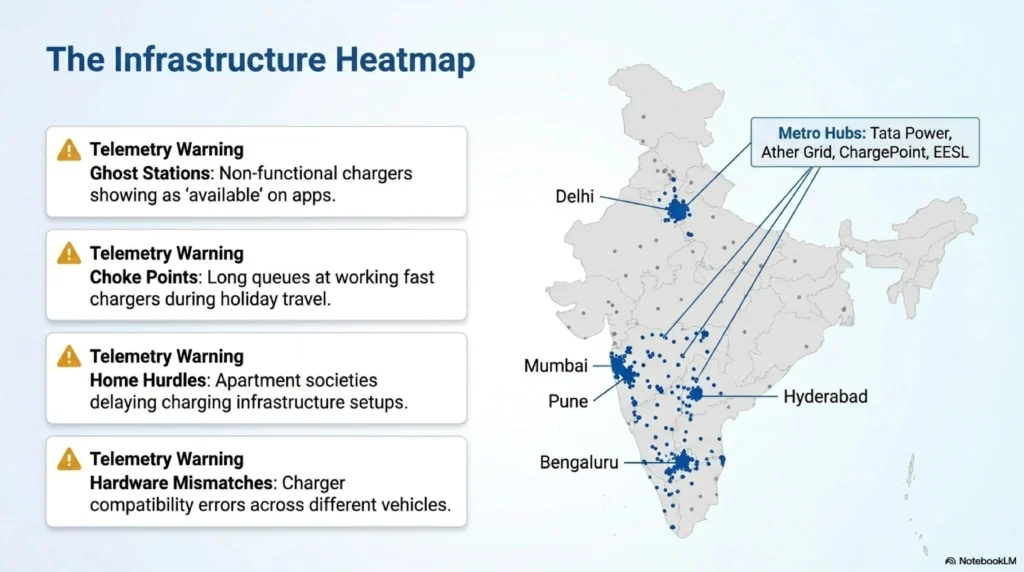
Practical problems Indian EV owners still report:
- Non-functional charging stations that show as available on apps
- Long queues at the few working fast chargers during holiday travel
- Apartment societies that have not yet set up charging infrastructure
- Charger compatibility mismatches — not every station supports every vehicle
For a daily city commuter with home charging, this may not affect routine life much. For someone who travels between cities regularly or lives in a smaller town without reliable home charging, infrastructure gaps are a real operational limitation today.
Charging Time Cannot Match Petrol Refuelling — Yet
Filling petrol takes under five minutes. EV charging does not come close to that on most setups.
Realistic charging times in Indian conditions:
- Standard home socket (15A): 5–8 hours for most electric cars, 4–6 hours for electric scooters
- AC wallbox (32A) at home: 3–5 hours for most electric cars
- DC fast charger (public): 45–60 minutes to reach 80% on compatible vehicles
For daily commuting, overnight home charging removes this problem entirely — you start every morning with a full battery without thinking about it.
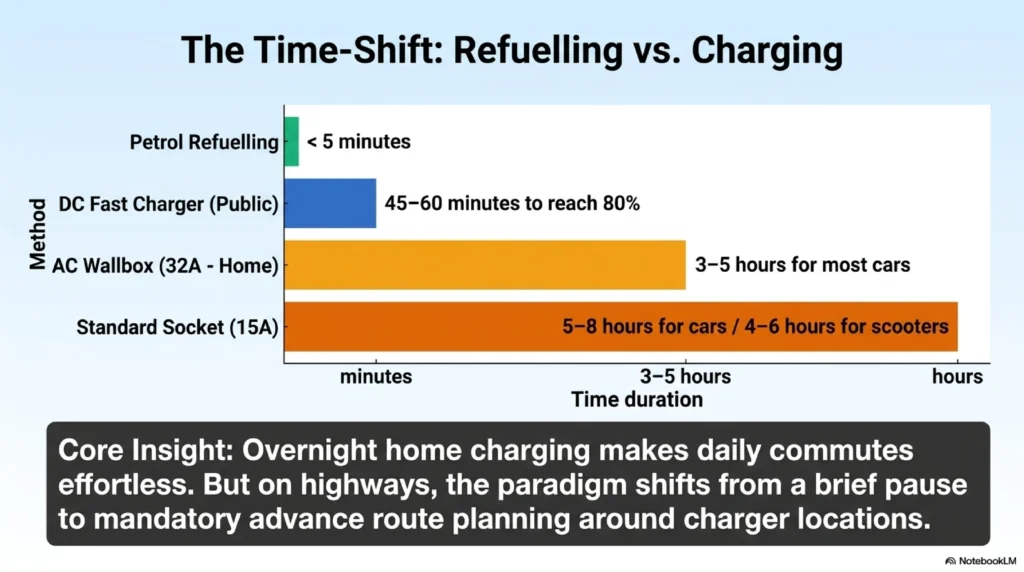
The issue surfaces during long highway trips. A petrol car driver stops for tea, fills the tank, and drives on. An EV driver plans stops around charger locations, waits 45–60 minutes, and may encounter a non-functional station. This requires a different mindset and more advance planning than most Indian buyers are used to.
DC fast charging is expanding, but it is not yet as seamlessly accessible as a petrol pump network.
Real-World Range Is Always Lower Than the Claimed Figure
Every EV manufacturer publishes a range figure. In India, this is typically tested under ARAI conditions — a controlled lab environment that does not reflect actual road use.
Real-world range in Indian conditions is consistently lower, typically 70–80% of the claimed figure, sometimes less.
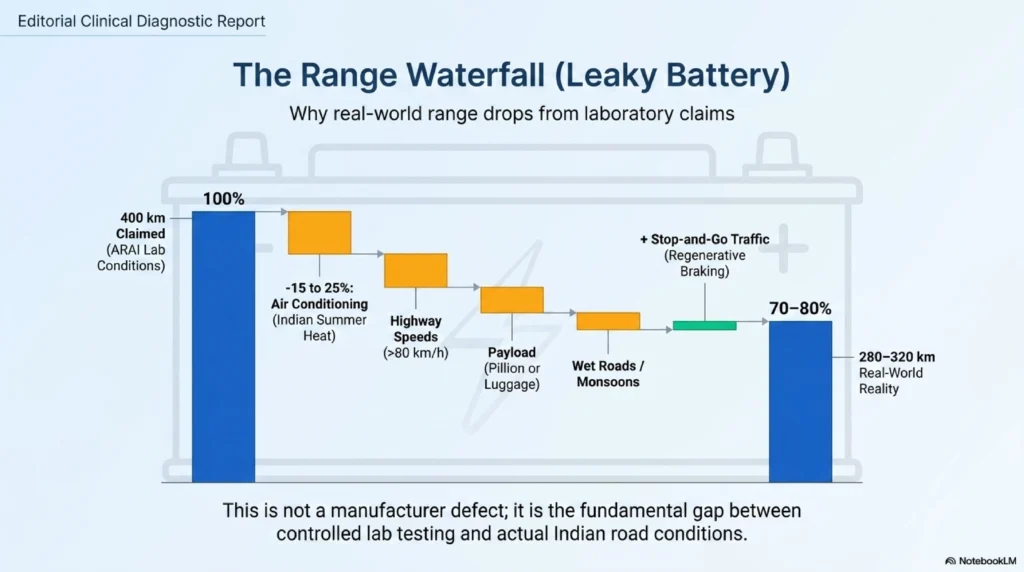
Factors that reduce range in actual use:
- Air conditioning during Indian summer heat — can reduce range by 15–25%
- Highway speeds above 80 km/h significantly increase energy consumption
- Stop-and-go traffic (partially offset by regenerative braking)
- Carrying pillion or luggage
- Battery age — capacity reduces gradually over years
- Monsoon conditions and wet roads
An EV claiming 400 km on paper may deliver 280–320 km in mixed real-world usage. This is not a defect — it is the gap between lab testing and actual conditions that exists for petrol mileage figures too. But EV buyers seem to feel it more acutely because range directly affects charging anxiety.
Battery Replacement Cost — The Long-Term Question
Most EV manufacturers now offer an 8-year or 1.6 lakh kilometre battery warranty, which is reassuring for new buyers. Within that period, significant battery degradation is covered.
The uncertainty begins after the warranty expires.
Battery replacement costs vary by vehicle and segment, but for electric cars, pack replacement can run into several lakhs. For electric scooters, costs are lower but still substantial relative to the vehicle’s age and resale value at that point.
Battery technology is improving, and costs are falling globally. But the question of what a battery replacement will actually cost in year 9 or 10 — and whether the vehicle will even be worth servicing at that stage — remains genuinely uncertain for the Indian market right now.
This also affects resale value, particularly for older EVs where battery health is unknown to the second-hand buyer.
You can read more Guides on EV Basics here.
Limited Model Choices in Several Segments
Electric scooters now have solid variety — Ather, Ola, TVS, Bajaj, Hero, and Ampere all offer multiple models across price points. That segment has matured.
Electric cars are a different story. Buyers looking for:
- An affordable electric hatchback under ₹8 lakh
- An electric MPV for a family of seven
- An electric pickup or load carrier
- A performance-oriented electric car
you will find that the options limited or non-existent in India today. The segment is still growing, but it is still far behind petrol in terms of variety and price spread.
Many buyers are genuinely waiting — not because of range anxiety or charging concerns, but simply because the right vehicle for their specific need does not exist yet at the right price.
Battery Manufacturing Has Its Own Environmental Cost
EVs produce zero tailpipe emissions during use, which is a genuine advantage for Indian cities already choking on vehicular pollution. But the full picture includes manufacturing.
Extracting lithium, cobalt, and nickel — the key materials in lithium-ion batteries — requires significant energy and carries environmental costs at the mining stage. Battery manufacturing plants have their own carbon footprint.
This does not cancel out the EV’s environmental advantage. Over a full vehicle lifetime, EVs in India still produce meaningfully lower overall emissions than petrol or diesel vehicles, even accounting for India’s coal-heavy electricity grid. But presenting EVs as completely clean ignores a real part of the equation.
As battery recycling infrastructure develops and India’s grid becomes greener, this gap will close further.
Who Should Think Carefully Before Buying an EV Right Now
The disadvantages above matter differently depending on your specific situation.
An EV may not be the right choice today if:
- You regularly travel long intercity distances and cannot plan charging stops
- You live in a tier-2 or tier-3 city with no home charging and poor public infrastructure
- Your daily commute is short enough that the running cost savings will take many years to recover the purchase premium
- You need an EV in a segment where good options simply do not exist yet
Here is a small illustration of Buyer profile. Go through it and see where your profile fits as per your current situation.
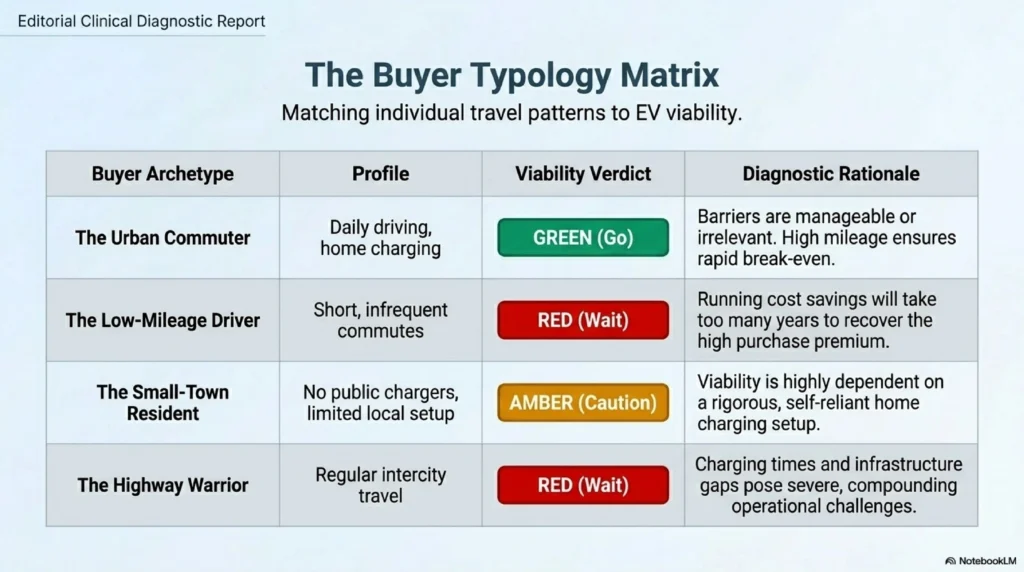
None of this means EVs are a poor product. For urban commuters with home charging, the disadvantages listed above are either manageable or irrelevant. The same vehicle in a different usage pattern is a genuine operational challenge.
Understanding your own travel pattern honestly is the most important step before deciding.
You can read more Guides on EV Basics here.