
India’s EV policy landscape has changed faster in the last five years than it did in the previous two decades. What began as a modest subsidy programme has grown into a full national strategy; one that now covers vehicle manufacturing, charging infrastructure, battery production, import regulations, and localisation mandates.
Today, the government is not just trying to get more people to buy electric vehicles. It is building an entire EV ecosystem inside the country. That includes homegrown battery manufacturing, public charging networks, local component supply chains, and a deliberate push to reduce India’s dependence on imported EV technology and time by time framing of different EV India Subsidy programs.
Whether you are planning to buy an electric scooter or car, want to set up a charging station, track EV industry developments, or simply want to understand how India plans to hit its 2030 targets; this article breaks it all down in plain and understandable manner.
At a Glance: India’s Active EV Schemes and Targets
| Policy / Scheme | Main Purpose | Key Highlights |
|---|---|---|
| FAME-II | EV adoption subsidies | Rs 10,000 crore outlay |
| EMPS 2024 | Transitional scheme post FAME-II | Focused on electric two-wheelers |
| PM E-DRIVE | Charging infrastructure expansion | Subsidies for public charging stations |
| EV30@30 Target | National EV adoption goal | 30% EV sales by 2030 |
| PMP Programme | Local manufacturing push | Higher import duties on EV components |
| New EV Policy 2024 | Attracting global EV manufacturers | Reduced import duty with localisation conditions |
How India’s EV Policy Evolved
India’s approach to electric mobility started cautiously, but the pace picked up sharply after 2019.
FAME-I: Where It All Started
The Faster Adoption and Manufacturing of Electric Vehicles scheme — commonly known as FAME — was India’s first structured attempt to push EV adoption through government subsidies.
The initial phase focused on:
- Pilot projects to test EV feasibility
- Hybrid vehicle support
- Early charging infrastructure trials
- Building basic public awareness
EV uptake during this phase remained limited. Charging stations were hard to find, vehicle prices were steep, battery technology was expensive, and most buyers in Indian cities were simply not aware of the options available.
FAME-II: The Real Push Begins
FAME-II was the policy that actually moved the needle for India’s EV market.
| Parameter | Details |
|---|---|
| Launch Date | April 1, 2019 |
| Total Budget | Rs 10,000 crore |
| Target Segment | Public transport and personal EV buyers |
| Covered Vehicle Types | Two-wheelers, three-wheelers, four-wheelers, buses |
The scheme offered battery-linked subsidies — meaning the incentive amount was tied to battery capacity in kWh rather than a flat discount. This rewarded vehicles with larger, more capable batteries.
FAME-II Subsidy Breakdown
| Vehicle Type | Subsidy Rate |
|---|---|
| Electric two-wheelers | Rs 15,000 per kWh |
| Electric three-wheelers | Rs 10,000 per kWh |
| Electric four-wheelers | Rs 10,000 per kWh |
| E-buses and trucks | Rs 20,000 per kWh |
For electric two-wheelers, the subsidy was capped at 40% of the vehicle’s ex-factory cost. This is what made affordable electric scooters from brands like Ola Electric, Ather, TVS, and Bajaj significantly cheaper on the showroom floor.
FAME-II had a measurable impact on:
- Electric scooter sales in Indian cities
- E-rickshaw adoption in Tier 2 and Tier 3 towns
- Overall EV awareness among urban buyers
EMPS 2024: Bridging the Gap After FAME-II
When FAME-II ended, the government introduced the Electric Mobility Promotion Scheme (EMPS) 2024 as a short-term measure to maintain momentum.
| Parameter | Details |
|---|---|
| Validity Period | April to July 2024 |
| Total Budget | Rs 500 crore (Rs 5 billion) |
| Primary Focus | Electric two-wheelers |
| Coverage | Mainly e-2Ws |
How EMPS Subsidies Compared to FAME-II
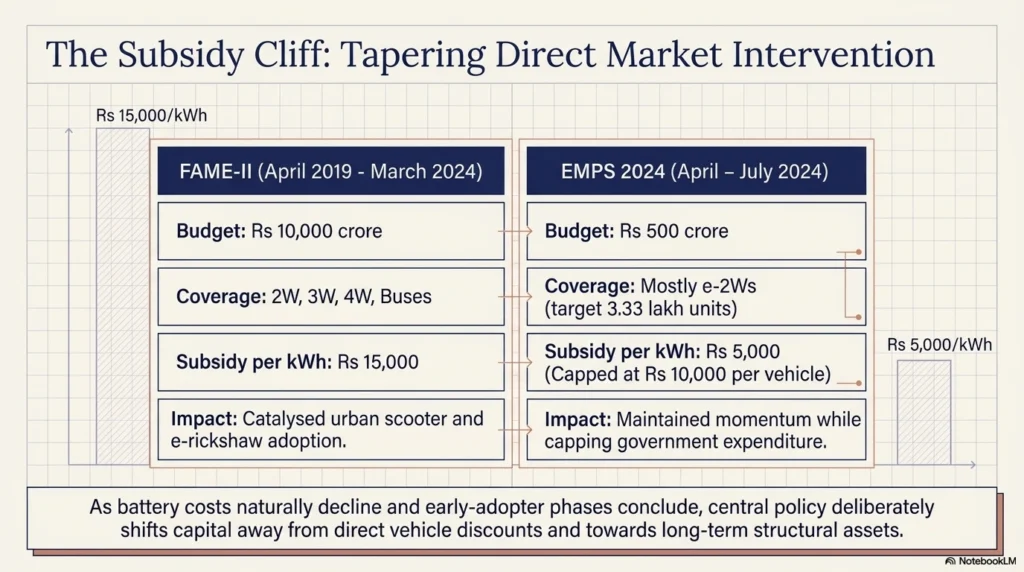
The incentives were noticeably smaller:
- Rs 5,000 per kWh (down from Rs 15,000 under FAME-II)
- Maximum subsidy capped at Rs 10,000 per electric scooter
Unlike FAME-II, EMPS 2024 did not cover electric cars or e-buses. The scheme was specifically aimed at keeping affordable electric scooter sales alive during the policy transition period. The government estimated EMPS would support around 3.33 lakh electric two-wheelers.
PM E-DRIVE Scheme: India’s Charging Infrastructure Push
PM E-DRIVE is currently one of the most consequential EV policies in India, not because it puts money in buyers’ pockets directly, but because it is building the charging backbone that will make long-distance and everyday EV use practical for everyone.
Its primary objectives are:
- Expanding public charging stations across cities and highways
- Supporting fast charging corridors on national routes
- Making EV charging accessible for buyers in smaller cities
PM E-DRIVE Charging Subsidies: How They Work
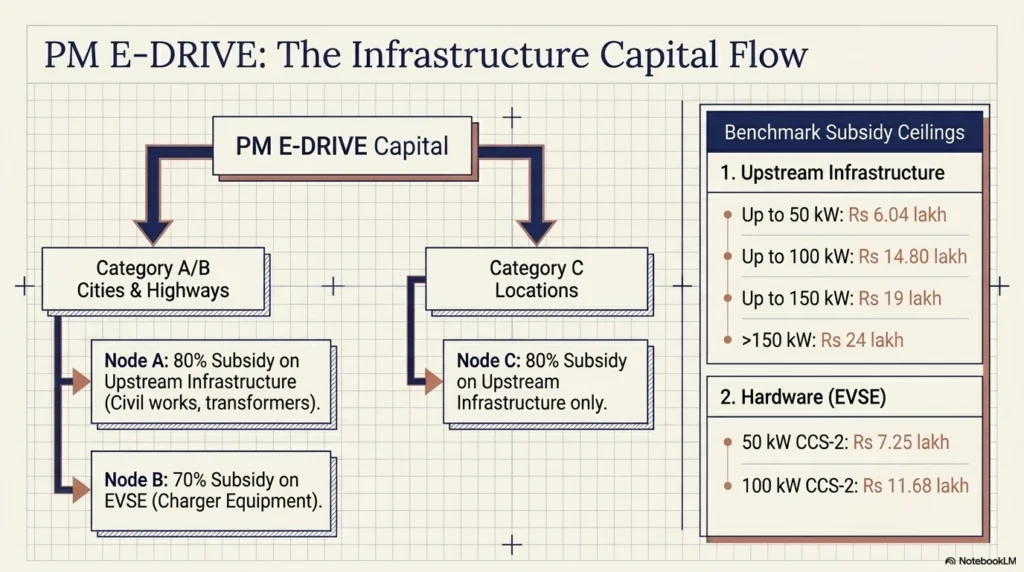
Category A and B Cities and Highway Locations
The scheme provides:
- 80% subsidy on upstream infrastructure (civil work, power connection, transformer, etc.)
- 70% subsidy on EV charging equipment (EVSE — the actual charger hardware)
Category C Locations
- 80% subsidy on upstream infrastructure only
Government Benchmark Costs for Charging Stations
To prevent cost inflation and bring consistency, the government has fixed benchmark costs that determine how much subsidy is actually paid out.
Upstream Infrastructure Benchmarks
| Charging Capacity | Benchmark Cost |
|---|---|
| Up to 50 kW | Rs 6.04 lakh |
| Up to 100 kW | Rs 14.80 lakh |
| Up to 150 kW | Rs 19 lakh |
| Above 150 kW | Rs 24 lakh |
Charger Equipment Benchmarks
| Charger Type | Benchmark Cost |
|---|---|
| 50 kW CCS-2 Charger | Rs 7.25 lakh |
| 100 kW CCS-2 Charger | Rs 11.68 lakh |
CCS-2 (Combined Charging System Type 2) is currently the standard DC fast charging protocol for electric four-wheelers in India. Knowing this benchmark is useful if you are planning to invest in charging infrastructure — the subsidy calculation is based on these figures, not your actual invoice.
India’s 2030 EV Target: What Is EV30@30?
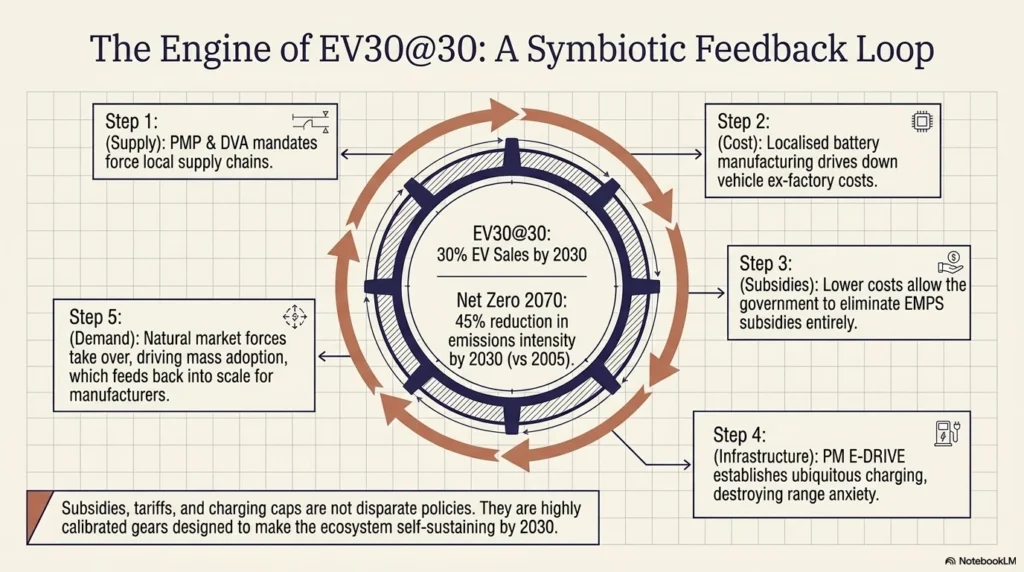
India officially targets 30% of all new vehicle sales to be electric by 2030. This is the EV30@30 goal, adopted as part of India’s broader clean energy transition.
Earlier drafts of the policy discussed more aggressive targets, including 100% electrification for certain vehicle categories, but the final national target settled at 30% overall EV adoption.
How EV Policy Connects to India’s Climate Commitments
India’s EV push is not standalone policy — it is directly tied to the country’s international climate pledges:
- Reduce emissions intensity by 45% compared to 2005 levels, by 2030
- Achieve net-zero emissions by 2070
Transport is one of the largest contributors to urban air pollution and crude oil imports in India. Reducing petrol and diesel vehicle dependency through EV adoption is considered a long-term structural necessity, not just an aspirational target.
Charging Infrastructure Policy: What the Rules Actually Say
One of the most common concerns for first-time EV buyers in Indian cities is the question of charging availability. The government has issued clear guidelines to address this.
The Urban Charging Grid Rule
The Ministry of Power recommends at least one public charging station within every 3 km x 3 km grid in cities. The goal is to reduce range anxiety by ensuring that no urban area is more than a few kilometres away from a public charger.
Highway Charging Requirements
- One charging station every 25 km on national highways
- Stations required on both sides of the road
- For heavy commercial EVs: one fast charging station every 100 km
Each highway charging station must have:
- Minimum two chargers
- At least 100 kW charging output
- Support for 200V to 1000V charging systems (covering both passenger EVs and commercial vehicles)
EV Charging Is a Service, Not a Licensed Utility
A significant policy clarification changed the landscape for private charging businesses: EV charging has been classified as a service under the Electricity Act 2003.
This means you do not need an electricity distribution licence to set up and operate a public EV charging station in India. This single clarification made it far easier for petrol pump owners, housing societies, malls, and entrepreneurs to enter the EV charging business.
EV Charging Tariffs: What You Actually Pay Per Unit
The government has capped what charging stations can charge customers, creating a predictable cost structure for EV owners.
DISCOM Electricity Supply Rates to Charging Stations
- During solar hours (9 AM to 4 PM): 0.8x the average cost of supply
- During non-solar hours: 1.2x the average cost of supply
This pricing structure is designed to encourage daytime charging, which coincides with peak solar generation — a practical policy for a country where solar capacity is expanding rapidly.
Service Charge Ceiling for Charging Station Operators
AC Slow Charging
| Time | Maximum Service Charge |
|---|---|
| Solar hours | Rs 2.5 per unit |
| Non-solar hours | Rs 3.5 per unit |
DC Fast Charging
| Time | Maximum Service Charge |
|---|---|
| Solar hours | Rs 10 per unit |
| Non-solar hours | Rs 12 per unit |
These tariff ceilings are applicable till March 31, 2026, and are expected to be revised based on grid costs and EV adoption levels.
Land Allocation for Charging Stations
Government entities can allocate land for EV charging infrastructure through revenue-sharing arrangements. The standard rate is Rs 1 per kWh of electricity billed at the station. Lease durations are typically fixed at 10 years.
This makes government land — including roadside plots, bus depots, and municipal parking areas — accessible to private charging operators, which is critical for scaling urban infrastructure quickly.
New EV Policy 2024: Bringing Global Manufacturers to India
The New EV Policy 2024 is primarily aimed at global EV manufacturers — companies like Tesla, BYD, and other international brands — who want to sell vehicles in India.
The government’s offer: come to India, manufacture here, and you get significant duty benefits. The conditions, however, are stringent.
Reduced Import Duty
Qualifying manufacturers can import EVs at 15% customs duty for CKD (Completely Knocked Down) units — substantially lower than the standard rates.
Minimum Investment Requirement
To qualify, a manufacturer must invest at least Rs 4,150 crore (approximately USD 500 million) in Indian manufacturing.
Domestic Value Addition (DVA) Rules
This is the most demanding part of the policy:
- 25% domestic value addition required within 3 years of approval
- 50% domestic value addition required within 5 years
This is among the strictest localisation conditions placed on any automotive policy globally, and it signals that the government is not interested in India becoming a simple assembly destination.
Import Volume Limits
- Maximum 8,000 imported EVs per year under the standard investment threshold
- If investment exceeds USD 800 million, up to 40,000 EVs can be imported overall — but still capped at 8,000 annually
Bank Guarantee Conditions
Manufacturers receive duty benefits only after they meet the localisation targets and complete their investment commitments. The government can withhold guarantees if conditions are not fulfilled on schedule.
Phased Manufacturing Programme (PMP): Building Indian Supply Chains
The PMP policy uses progressive import duty increases to nudge EV manufacturers towards local sourcing and assembly.
Vehicle-Level Import Duties
| Vehicle Type | BCD Rate |
|---|---|
| CBU Buses and Trucks | 50% |
| SKD Passenger Vehicles and Three-wheelers | 30% |
| SKD Two-wheelers, Buses and Trucks | 25% |
| CKD Units | 15% |
Component-Level Import Duties
The government has also imposed 15% duty on:
- Lithium-ion cells
- Battery packs
- Motors
- Controllers
- Chargers
This is designed to make it more economical for manufacturers to source these parts from Indian suppliers rather than importing them — gradually building a domestic EV component ecosystem.
Safety Standards for Public EV Charging Stations
Charging infrastructure in India must comply with specific technical and safety regulations.
Mandatory Inspection Schedule
- Inspection required before a charging station is energised for the first time
- Annual inspections for the first 3 years of operation
- Inspections every 4 years after that
Weather Protection Requirements
Outdoor charging equipment must meet at least IPX4 protection standards. In Indian conditions — monsoon flooding, summer heat touching 45°C, coastal humidity, and dusty highway environments — this is a baseline requirement, not a luxury.
Challenges That Still Remain
Despite the policy momentum, several real problems continue to slow EV adoption in India.
High Vehicle Prices
Even with subsidies, electric vehicles remain more expensive than comparable petrol alternatives for most buyers. Battery cost is still the dominant factor, and until Indian cell manufacturing reaches scale, this gap will not close easily.
Charging Infrastructure in Smaller Towns
Metro cities and major highways are improving. But if you live in a Tier 3 town or use state highways, you will still struggle to find reliable fast chargers. This unevenness in infrastructure remains a genuine barrier.
Battery Import Dependency
India still imports a large share of lithium-ion cells and the raw materials that go into them. Local battery manufacturing is picking up — with PLI-backed projects from companies like Ola Electric, Amara Raja, and Exide — but meaningful scale is still a few years away.
Policy Uncertainty
Frequent changes in subsidy structure create confusion among buyers, manufacturers, and dealers alike. The shift from FAME-II to EMPS 2024, with its reduced subsidy rates, is one clear example of how policy transitions can dampen short-term demand. State EV policies have also changed multiple times in several states, adding to the uncertainty.
What These Policies Mean for Regular EV Buyers
If you are evaluating whether to buy an EV in India today, here is what these policies actually mean for you:
- Subsidies directly reduce the purchase price of electric two-wheelers and some three-wheelers
- Many states offer additional road tax exemptions on top of central subsidies
- Charging tariff caps mean your per-unit running cost is regulated and predictable
- The grid charging rule means urban fast charging access will continue to improve
- The New EV Policy 2024 will likely bring more international EV options to Indian showrooms over the next three to five years
If localisation succeeds as planned, battery costs should come down, and EV prices should become genuinely competitive with petrol vehicles — possibly by the late 2020s.
Where India’s EV Policy Is Headed Next
India’s EV strategy is moving beyond buyer subsidies into industrial and infrastructure policy. The next phase will likely prioritise:
- Domestic lithium-ion cell manufacturing at scale
- Faster highway charging corridors for inter-city travel
- Urban fleet electrification — buses, auto-rickshaws, delivery vehicles
- Battery recycling and second-life battery regulation
- Grid integration for managing EV charging load during peak hours
- Renewable energy linkage for greener charging
Heavy commercial EVs — trucks and long-haul freight vehicles — are also expected to receive more focused policy attention in the coming years, as they represent a major share of India’s fuel import bill.
State EV Policies
Over and above National EV Policies; The states of India are also drafting their own EV policies in line with national policy to become a part of nation’s EV growth engine. You can find state EV policies and subsidy benefits below. The list will be updated as long as possible.
- Maharashtra EV Policy
- Maharashtra EV Subsidy
Frequently Asked Questions
What is EV India Policy and which schemes are currently active?
India’s EV India Policy is a combination of central government schemes and regulations. Currently active schemes include FAME-II (now concluded but still relevant for understanding the market), EMPS 2024, PM E-DRIVE for charging infrastructure, the New EV Policy 2024 for manufacturing, and various state-level EV policies that operate alongside central schemes.
What is India’s EV target for 2030?
India’s official target under the EV30@30 goal is for 30% of all new vehicle sales to be electric by 2030. This applies across vehicle categories including two-wheelers, three-wheelers, passenger cars, and buses.
Do you need a licence to run an EV charging station in India?
No. EV charging has been legally classified as a service under the Electricity Act 2003. This means you do not need an electricity distribution licence to operate a public EV charging station.
What is the 3 km charging station rule?
The Ministry of Power recommends one public charging station within every 3 km x 3 km grid in urban areas. This is a guideline aimed at reducing range anxiety in Indian cities.
Are EV subsidies still available in India in 2026?
Yes, though the structure has changed significantly since FAME-II ended. Current support depends on your vehicle category, the state you purchase in, and the central scheme in effect at the time of purchase. Charging infrastructure subsidies under PM E-DRIVE are also active for station operators.
Also Read: