
As the EV Subsidy is getting more importance in the Indian EV Policy; Electric vehicles are no longer a novelty on Indian roads. With petrol prices staying persistently high and daily running costs eating into household budgets, more Indian buyers are seriously considering the switch.
But present EV Policy of India other state government subsidies remain a major deciding factor — and the structure has changed significantly since FAME-II ended.
If you are planning to buy an electric scooter, electric car, or set up a charging station, here is a clear breakdown of what EV subsidies are actually available in India in 2026 — who gets what, how much, and from which scheme.
What Exactly Is an EV Subsidy?
"An EV subsidy is a financial benefit provided by the government to reduce the upfront cost of owning an electric vehicle."
The Indian government pushes EV adoption for several concrete reasons:
- Reducing dependence on oil imports
- Cutting urban air pollution, especially in cities like Delhi and Mumbai
- Supporting domestic battery manufacturing under the PLI framework
- Improving national energy security
- Working towards India’s 2070 net-zero commitment
These incentives reach buyers through multiple channels:
- Direct purchase subsidies
- Road tax exemptions
- Registration fee waivers
- Income tax deductions
- Charging infrastructure support
- Lower GST rates compared to petrol and diesel vehicles
One important thing to understand: EV subsidies in India operate at two levels — Central Government and State Government. This is why the final benefit you receive can vary heavily depending on which state you register your vehicle in.
Central Government EV Subsidy Schemes
FAME-II: The Foundation Scheme
The most significant EV subsidy programme in India was FAME-II — Faster Adoption and Manufacturing of Electric Vehicles. It ran from 1 April 2019 with a total budget of Rs 10,000 crore and covered electric two-wheelers, three-wheelers, cars, buses, and charging infrastructure.
FAME-II subsidy rates were structured as follows:
| Vehicle Type | Subsidy per kWh | Typical Battery Size |
| Electric Two-Wheelers | Rs 15,000/kWh | ~2 kWh |
| Electric Three-Wheelers | Rs 10,000/kWh | ~5 kWh |
| Electric Cars | Rs 10,000/kWh | ~15 kWh |
| Electric Buses | Rs 20,000/kWh | ~250 kWh |
The FAME-II scheme was responsible for bringing electric scooter prices down noticeably during the early adoption phase. Models from Ola Electric, TVS iQube, and Ather Energy became more accessible largely because of this support.
EMPS 2024: The Bridge Scheme
After FAME-II concluded, the government introduced the Electric Mobility Promotion Scheme (EMPS) 2024 as a short-term transition arrangement.
| Parameter | Details |
|---|---|
| Validity | April 2024 to July 2024 |
| Total Budget | Rs 500 crore |
| Target Volume | 3,33,387 electric two-wheelers |
| Coverage | Only two-wheelers and three-wheelers (no cars, no buses) |
| Subsidy Rate | Rs 5,000 per kWh (Maximum cap of Rs 10,000 per electric scooter) |
The subsidy rate under EMPS dropped sharply to Rs 5,000 per kWh, with a maximum cap of Rs 10,000 per electric scooter. This reduction was intentional — the government wanted manufacturers to move towards cost competitiveness rather than continued subsidy dependence.
PM E-DRIVE Scheme: The Current Framework
The most active central scheme right now is PM E-DRIVE, approved in September 2024 with a total outlay of Rs 10,900 crore.
Unlike earlier schemes that focused heavily on direct vehicle discounts, PM E-DRIVE prioritises the broader EV ecosystem — particularly charging infrastructure and commercial fleet electrification.
Key focus areas under PM E-DRIVE:
- EV charging infrastructure (Rs 2,000 crore allocated)
- Electric buses and trucks
- Electric ambulances
- Electric two-wheelers and three-wheelers
EV Charging Infrastructure Subsidies Under PM E-DRIVE
This is currently the most active area of EV subsidy spending in India. The government wants rapid expansion of public charging networks across highways, metro cities, transit hubs, and fuel stations.
Subsidy by Location Category
| Category | Location Type | Infrastructure Cost Subsidy | Charger Hardware Subsidy |
|---|---|---|---|
| Category A | Government offices, hospitals, educational institutions | 100% | 100% |
| Category B | Highways, airports, metro stations, bus depots, PSU fuel stations | 80% | 70% |
| Category C | Shopping malls, commercial parking, streets | 80% (Upstream infrastructure only) | Not Applicable |
Benchmark Costs for Charger Subsidy Calculation
The Bureau of Energy Efficiency (BEE) has fixed benchmark infrastructure costs that determine the actual subsidy amount:
Infrastructure cost caps:
| Infrastructure Capacity | Maximum Cost Cap |
|---|---|
| Up to 50 kW | Rs 6.04 lakh |
| Up to 100 kW | Rs 14.80 lakh |
| Up to 150 kW | Rs 19 lakh |
| Above 150 kW | Rs 24 lakh |
CCS-II charger hardware benchmarks:
| Hardware Type | Benchmark Cost |
|---|---|
| 50 kW charger | Rs 7.25 lakh |
| 100 kW charger | Rs 11.68 lakh |
State EV Subsidies in India: Where the Real Savings Often Come From
For individual buyers, state-level benefits frequently deliver more direct savings than central schemes. These typically include road tax exemptions, registration fee waivers, purchase subsidies, concessional EV electricity tariffs, and home charger support.
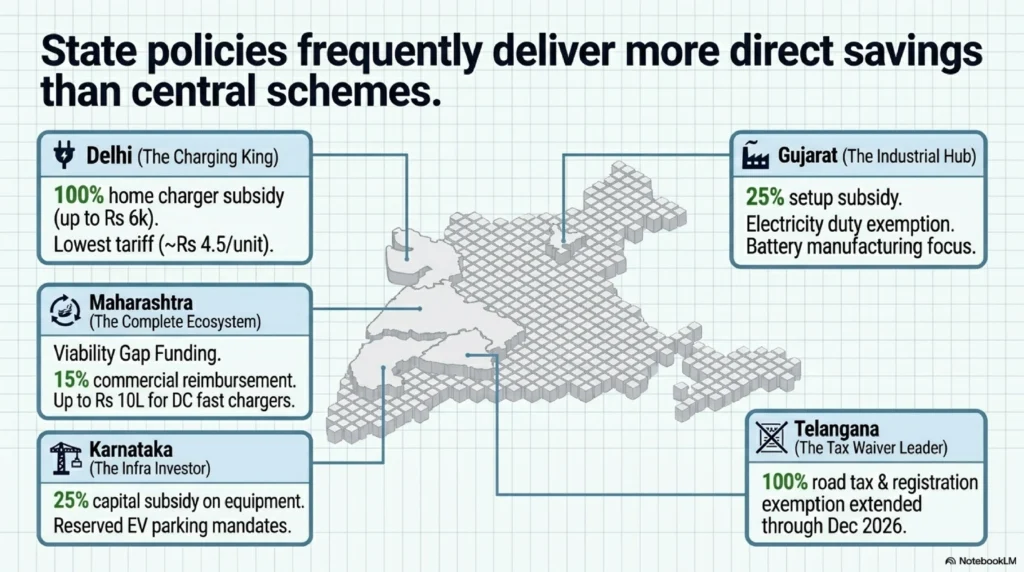
Above is a rough and at a glance illustration of some of the Indian state’s subsidy policies. We will explore it state by state below. Let’s do it.
Delhi
Delhi continues to be one of India’s most EV-friendly states.
- 100% subsidy up to Rs 6,000 on home EV charger installation
- EV charging tariff of approximately Rs 4.5 per unit — among the lowest in the country
- Registration fee waiver
- Active public charging expansion support
For daily commuters in city traffic, the low charging tariff alone makes a significant difference to monthly running costs.
Maharashtra
Maharashtra has built one of the more complete EV ecosystems in India.
- Road tax exemption
- Registration fee waiver
- Concessional electricity tariff for EV charging
- Viability Gap Funding for charging station operators
- 15% charger cost reimbursement for commercial operators
- Up to Rs 10 lakh support for DC fast charger installation
Karnataka
Karnataka is investing heavily in charging infrastructure, particularly around Bengaluru.
- 25% capital subsidy on EV charging equipment
- Public charging expansion programme
- Reserved EV parking mandates
- One of India’s largest existing charging networks
Gujarat
Gujarat’s approach combines buyer benefits with industrial investment.
- 25% subsidy for public charging station setup
- Electricity duty exemption for EV charging
- Lower road tax for EV buyers
- Strong focus on battery manufacturing under state industrial policy
Telangana
Telangana has extended its EV incentives through December 2026:
- 100% road tax exemption
- 100% registration fee exemption
Dont see your state above? Dont worry; we have discussed EV Policies and Subsidies for almost all states in detail as separate articles.
Income Tax Benefit on EV Loans — Section 80EEB
Individual buyers who take a loan to purchase an electric vehicle can claim a tax deduction of up to Rs 1.5 lakh on the interest paid, under Section 80EEB of the Income Tax Act.
This benefit applies only to individual buyers, not businesses or fleet operators. For someone in the 30% tax bracket taking a loan for an electric car, this can translate to meaningful annual savings over the loan tenure.
GST on Electric Vehicles vs Petrol Vehicles
The GST difference between EVs and conventional vehicles is substantial and often underappreciated as a subsidy:
| Vehicle Type | GST Rate |
| Electric Vehicles | 5% |
| Petrol/Diesel Vehicles | 28% + cess |
This lower GST directly reduces the ex-showroom price of every EV sold in India. EV chargers and public charging equipment also attract lower GST, making the full ownership chain more affordable.
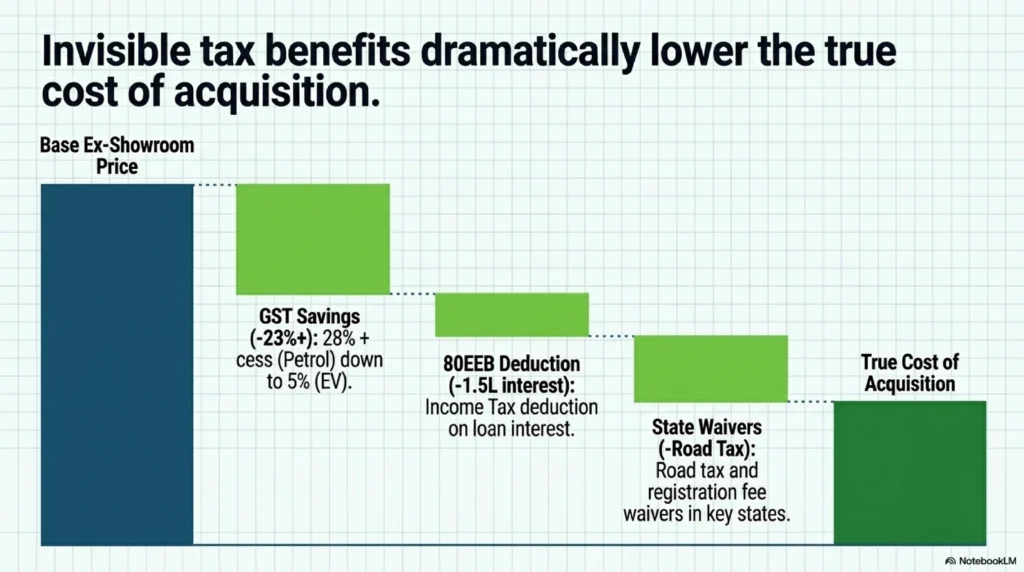
Above illustration shows how dramatically the true aquisition cost may reduce. if you take into consideration GST savings upfront and then go on with adding it up wth Income Tax benefits and Tax waivers given by your state; it will significantly reduce the final aquisition cost.
Public Charging Infrastructure Rules
The government has set minimum density guidelines for EV charging networks:
- Urban areas: one charging station within every 3 km × 3 km grid
- Highways: one charging station every 25 km
- Heavy vehicle corridors: one fast charging station every 100 km, with at least two 100 kW chargers minimum
On the electricity side, a useful clarification was made: EV charging is classified as a service, not electricity distribution. This means setting up a private charging business does not require a distribution licence — a practical step that has helped smaller charging operators enter the market.
Manufacturing Incentives and Localisation Rules
India’s EV policy now pushes for genuine local manufacturing rather than assembly-level imports.
For global EV brands seeking import duty benefits under the New EV Policy 2024, the conditions are:
- Minimum investment of Rs 4,150 crore in India
- 25% Domestic Value Addition (DVA) within three years
- 50% DVA within five years
CKD import duty has been reduced to 15%, but with a cap of 8,000 imported units per year. This policy primarily targets global players like Tesla and others evaluating Indian manufacturing operations.
Which EVs Actually Get the Most Subsidy Right Now?
Currently, the strongest direct buyer subsidies remain concentrated in:
- Electric scooters and two-wheelers
- Electric three-wheelers (especially for last-mile delivery and auto segments)
For electric cars, direct central subsidies are now largely phased out for private buyers. The benefit today comes from:
- Lower GST (5% vs 28%+cess)
- State-level road tax and registration waivers
- Section 80EEB tax deduction on loan interest
- Significantly lower running cost compared to petrol
How Much Can You Actually Save?
Savings depend on vehicle type, battery size, your state, daily usage, and local electricity tariff. A rough practical picture:
- Electric scooter owners in states like Delhi or Telangana can realistically save Rs 50,000 to Rs 1 lakh over three to four years when combining state subsidies, lower running costs, and tax benefits.
- Electric car owners see the biggest gains over time — lower fuel bills, lower maintenance, and long-term running costs that can beat comparable petrol cars by a wide margin on a per-kilometre basis.
What to Check Before You Buy
Do not assume all subsidies apply automatically everywhere. Before finalising your purchase, verify:
- Whether your state’s scheme is currently active and funded
- Vehicle price cap eligibility (some schemes only apply below a certain ex-showroom price)
- Battery size eligibility requirements
- Which state you are registering in (this affects which state benefits apply)
- Whether the scheme is quota-based and likely to close early
- Whether your dealer is registered to process subsidy claims
Some state schemes — particularly those with fixed annual budgets — can exhaust their quota before the year ends.
Here is a full EV Guide for First Time Buyers:
Where Is India’s EV Subsidy Policy Heading?
The direction is clearly shifting. Early EV policy in India was built around direct purchase discounts to drive adoption. The newer phase is about building the underlying ecosystem.
PM E-DRIVE’s emphasis on charging infrastructure, battery manufacturing support, and commercial fleet electrification signals that future EV growth is expected to be driven by lower total cost of ownership rather than upfront subsidies.
India’s targets remain ambitious:
- 30% EV sales share by 2030
- 45% reduction in emissions intensity
- Net-zero emissions by 2070
For buyers entering the market in 2026, many states are still running strong incentive programmes and public charging coverage is improving steadily — particularly on national highways and in metro cities. The combination of lower running costs, reduced taxes, and available state benefits still makes this a practical time to consider the switch.
Frequently Asked Questions
Is FAME-II still active in India?
FAME-II has transitioned into EMPS 2024 and PM E-DRIVE. Its direct subsidy window is closed, but the policy foundation it built continues to influence the current EV ecosystem.
Which EV gets the highest subsidy in India in 2026?
Electric two-wheelers historically received the strongest direct per-unit support and continue to benefit most from state-level incentives. For central subsidies, PM E-DRIVE also covers electric three-wheelers and commercial vehicles.
Do electric cars still get subsidy in India?
Direct central purchase subsidies for private electric cars are now largely unavailable. However, lower GST, road tax exemption, registration fee waivers at the state level, and Section 80EEB tax benefits together still offer meaningful savings.
Which state gives the best EV subsidy?
Delhi, Maharashtra, Karnataka, Gujarat, and Telangana currently offer the most comprehensive EV benefits. Delhi stands out particularly for home charger support and low charging tariffs.
Is home EV charger installation subsidised?
Delhi offers a direct subsidy of up to Rs 6,000 for home charger installation. Other states mainly provide concessional electricity tariffs rather than direct hardware subsidies.