
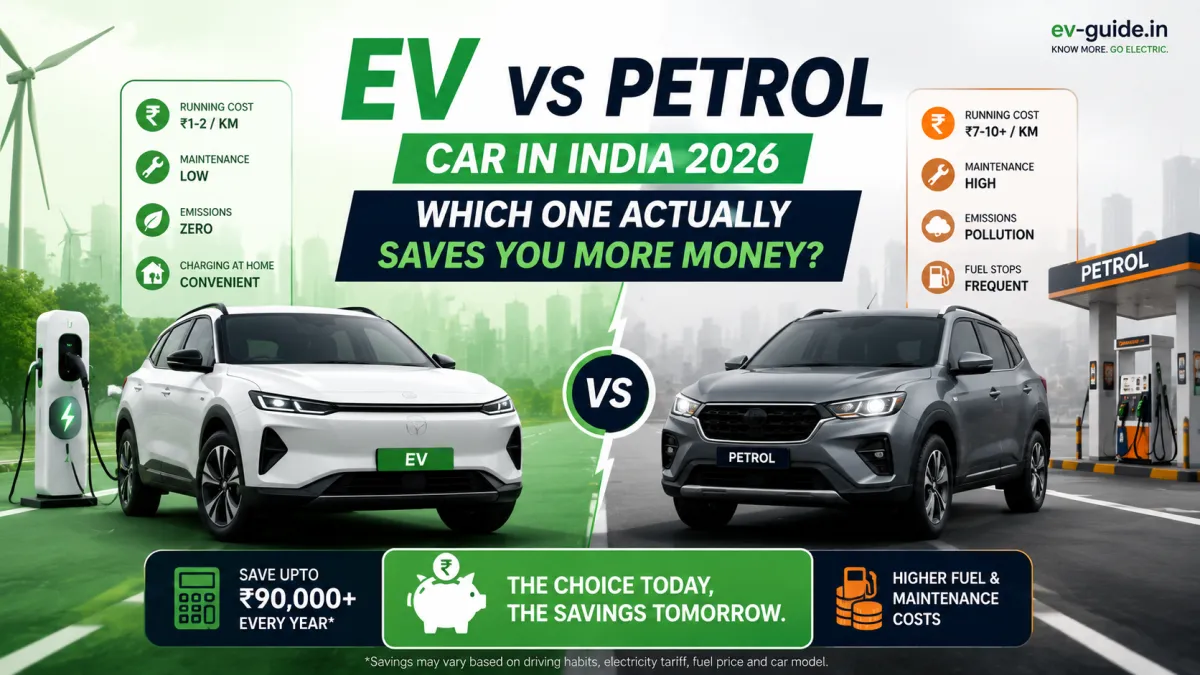
If you are buying a new car this year, one question keeps coming up that is “EV vs Petrol”: should you go electric or stick with petrol?
A few years ago, the answer for most Indian buyers was simple — petrol, without much debate. EVs were expensive, ranges were limited, and public charging barely existed outside a handful of metro cities. That picture has changed considerably.
Petrol prices in most Indian cities continue hovering near ₹100 per litre. Public chargers are appearing on major highways. And modern EVs now cover enough distance for typical city commutes without any anxiety.
But petrol cars still hold real advantages. You can refuel in under five minutes anywhere in India, long-distance travel is straightforward, and the showroom price is usually lower.
So which one actually makes more sense for an Indian buyer in 2026?
The honest answer depends on where you live, how much you drive, whether you can charge at home, and what your monthly budget looks like. This comparison covers every practical ownership factor — purchase cost, running cost, maintenance, charging convenience, highway usability, long-term savings, and resale — so you can make a decision that fits your actual situation.
EV vs Petrol Car: At a Glance
| Feature | Petrol Car | Electric Car |
|---|---|---|
| Upfront Cost | Lower | Higher |
| Running Cost | ₹7–₹10+ per km | ₹1–₹2 per km |
| Maintenance | Higher | Lower |
| Refuelling / Charging | 3–5 minutes | 30 min to overnight |
| Tailpipe Emissions | Yes | Zero |
| City Driving | Good | Excellent |
| Highway Trips | Better | Improving rapidly |
| Home Charging Needed | No | Strongly recommended |
| Noise and Vibration | More | Very low |
| Long-Term Savings | Limited | Very high |
Below is more clearer pictorial representation of the upfront cost of EV vs Petrol.
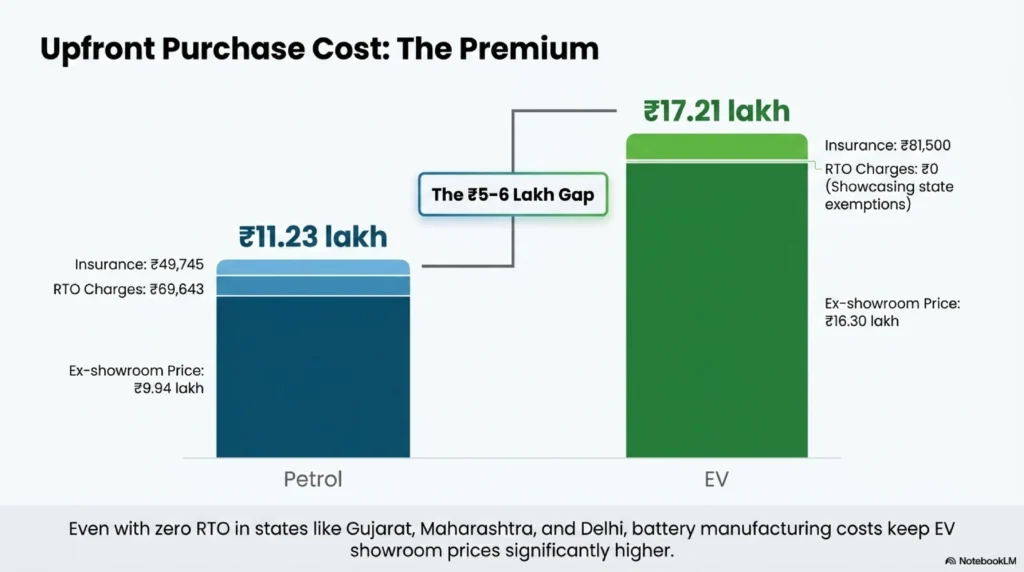
Clearly the Upfront investment in an EV feels burdensome particularly the large middle-class and upper middle-class of the indian society and needs consideration.
How These Two Technologies Actually Differ
A petrol car runs on an internal combustion engine. Petrol ignites inside the engine, creates controlled combustion, and that energy moves the wheels. This technology has been refined over decades and is familiar to every Indian mechanic, spare parts dealer, and roadside workshop.
An EV works on an entirely different principle. It uses:
- A battery pack
- Electric motors
- Power electronics
- Regenerative braking
There is no engine oil, no spark plugs, no traditional gearbox, and no exhaust pipe. That mechanical simplicity is precisely why running and maintenance costs are lower. But the battery pack is expensive to manufacture, which is why EVs still cost more upfront.
This gap — lower purchase cost versus lower running cost — sits at the heart of every EV vs petrol comparison in India.
Purchase Cost: EVs Still Come at a Premium
The first thing Indian buyers notice is the price difference.
Even after road tax exemptions and state-level subsidies in some states like Gujarat, Maharashtra, and Delhi, electric cars cost noticeably more than equivalent petrol variants.
Take the Tata Nexon as a familiar example. The petrol variant typically lands around ₹11–12 lakh on-road. The EV variant can cross ₹17 lakh depending on the city and variant.
Here is a simplified ownership cost comparison:
| Expense | Petrol SUV | EV SUV |
|---|---|---|
| Ex-showroom Price | ₹9.94 lakh | ₹16.30 lakh |
| RTO Charges | ₹69,643 | ₹0 (in some states) |
| Insurance | ₹49,745 | ₹81,500 |
| Total Initial Cost | ₹11.23 lakh | ₹17.21 lakh |
The gap of roughly ₹5–6 lakh at purchase is the main reason many first-time buyers still lean petrol. But the running cost story changes this equation significantly over time.
Running Cost: Where EVs Change the Calculation
This is where the EV advantage becomes very hard to ignore.
In Indian conditions, a petrol car typically costs ₹7 to ₹10 per kilometre, depending on fuel prices, traffic conditions, AC usage, driving style, and vehicle weight.
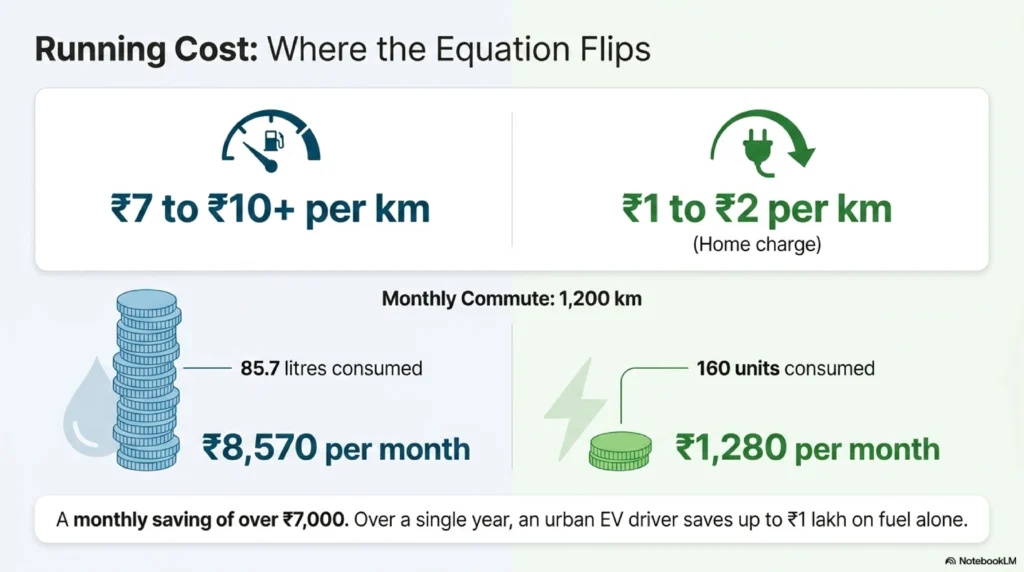
An EV charged at home costs roughly ₹1 to ₹2 per kilometre.
That gap, compounded over months and years, is enormous.
Monthly Cost Example
Assuming 1,200 km per month, petrol at ₹100/litre, electricity at ₹8/unit, petrol mileage of 14 km/l, and EV efficiency of 7.5 km/kWh:
Petrol car: 85.7 litres consumed → ₹8,570 per month
Electric car: 160 units consumed → ₹1,280 per month
That is a monthly saving of over ₹7,000. Over one year, many EV owners in Indian cities are saving ₹80,000 to ₹1 lakh on fuel alone.
Why Indian City Traffic Suits EVs Naturally
Most Indian metro cities deal with heavy traffic, frequent braking, stop-and-go movement, and slow speeds through congested stretches. These are exactly the conditions where petrol engines work inefficiently.
An EV recovers energy through regenerative braking every time you slow down or stop. City congestion that drains a petrol car actually hurts an EV far less.
This is why EV owners in cities like Bengaluru, Pune, Delhi, Hyderabad, Ahmedabad, and Mumbai consistently report very low per-kilometre costs. If your daily commute is between 20 km and 70 km within the city, an EV fits that usage extremely well.
Maintenance Costs: Fewer Parts Means Fewer Bills
A petrol car requires regular attention to:
- Engine oil and oil filter changes
- Air filters and spark plugs
- Clutch assembly wear
- Exhaust system upkeep
- Transmission servicing
An EV skips most of these entirely. Typical EV maintenance involves brake fluid checks, coolant levels, cabin air filter replacement, tyre rotation, and software diagnostics.
| Vehicle Type | Average Annual Service Cost |
|---|---|
| Petrol Car | ₹7,000–₹12,000 |
| EV | ₹3,000–₹6,000 |
Over six to eight years, that difference adds up to a meaningful amount.
Charging vs Refuelling: The Most Practical Difference
A petrol car can be refuelled almost anywhere in India within five minutes. That convenience is real and should not be underestimated, especially in smaller towns and rural areas.
An EV requires charging, and the experience varies significantly based on your charger type:
| Charger Type | Approximate Charging Time |
|---|---|
| 15A home socket | 8–20 hours |
| 7.2 kW home wallbox charger | 5–8 hours |
| DC fast charger (public) | 30–60 minutes |
For city users with a home charger, this is rarely a problem in practice. You plug in overnight and leave in the morning with a full charge — similar to how you charge a phone.
The real difficulty is for buyers living in apartment buildings without dedicated parking or society charging permissions. This is currently one of the biggest practical barriers for urban EV adoption in India.
Highway Trips: Petrol Still Has the Edge
India’s charging network on highways is improving, but gaps remain — especially on state highways, remote hill routes, and less-travelled inter-state roads.
If you regularly drive 300 to 700 km highway trips, travel through rural areas, or make frequent visits to hill stations during peak summer or monsoon season, petrol cars still offer more convenience. Refuelling is faster, fuel stations exist even in remote areas, and there is no need to plan the route around charger availability.
That said, specific corridors now have reliable fast-charging coverage:
- Mumbai–Pune
- Delhi–Jaipur
- Bengaluru–Chennai
- Ahmedabad–Udaipur
- Hyderabad–Vijayawada
For occasional road trips on well-connected routes, modern EVs from Tata, MG, and Hyundai can manage reasonably well with some advance planning.
Battery Life: What Indian Buyers Actually Need to Know
Battery degradation is one of the most common concerns among Indian buyers, particularly given India’s harsh summer heat and the demands of city charging cycles.
In reality, modern EV battery packs have been lasting longer than most buyers expected. Most EV manufacturers now offer an 8-year or 1.6 lakh km battery warranty as standard.
Degradation in Indian conditions is gradual. Most owners see around 1 to 3 percent annual degradation depending on climate, charging habits, and how frequently the battery is charged to 100 percent. Even after several years, most EVs retain enough practical range for everyday city usage.
Petrol engines are also durable, but contain significantly more moving parts. As a petrol car ages, engine wear increases, fuel efficiency drops, maintenance costs rise, and components like the transmission and clutch need attention.
Both technologies age — just in different ways.
8-Year Ownership Cost: The Full Picture
Looking at total cost of ownership over 8 years gives a clearer picture than just comparing showroom prices.
Assuming 50 km daily driving, roughly 18,250 km annually:
Petrol vehicle running costs over 8 years:
| Expense | Cost |
|---|---|
| Fuel | ₹10.22 lakh |
| Service | ₹60,000 |
| Insurance | ₹80,000 |
| Total Running Cost | ₹16.62 lakh |
EV running costs over 8 years:
| Expense | Cost |
|---|---|
| Charging | ₹1.22 lakh |
| Service | ₹48,000 |
| Insurance | ₹1.28 lakh |
| Total Running Cost | ₹10.58 lakh |
Overall ownership cost including purchase price:
| Vehicle | Total Cost |
|---|---|
| Petrol | ₹26.88 lakh |
| EV | ₹26.24 lakh |
Over 8 years at moderate usage, the costs come very close to each other. High-mileage users will see the EV come out ahead faster.
If you want to dive deeper into Saving calculations: Use our EV Savings Calculator. You will be able to calculate annual savings for each fuel type and for both two wheelers and cars.
The EV Break-Even Point
The break-even point is simply how long it takes for your fuel savings to recover the higher purchase price of the EV.
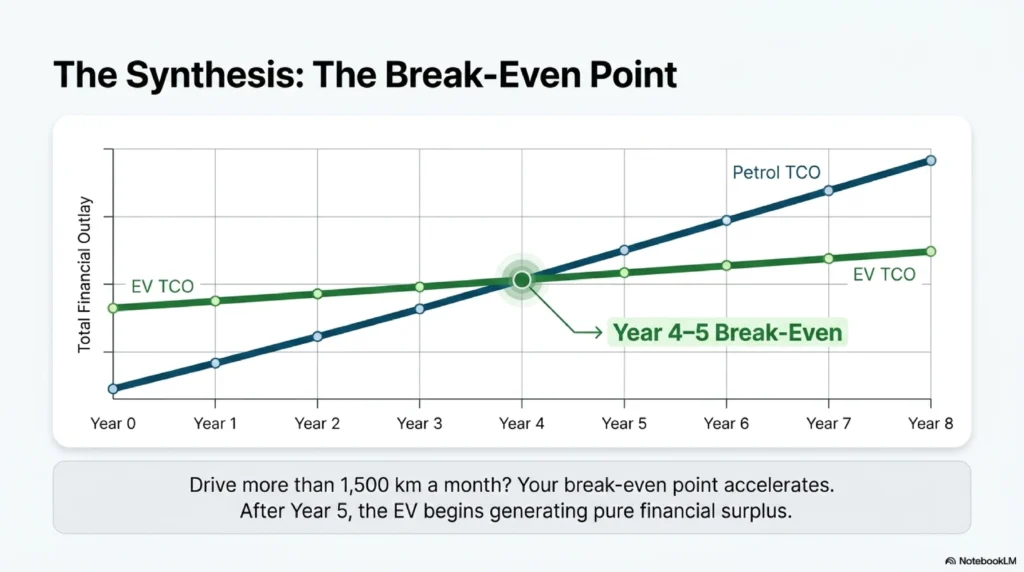
For most Indian compact SUVs, the EV premium over a comparable petrol variant is around ₹3–4 lakh. If your monthly savings on fuel and maintenance are ₹6,000 to ₹8,000, the break-even typically arrives in four to five years.
Drive more than 1,500 km per month and that recovery happens faster.
This is why EVs make strong financial sense for:
- Daily office commuters covering 40–80 km per day
- Cab and taxi operators
- Urban families with heavy city usage
- Anyone who already owns a petrol or diesel car for longer trips
Environmental Impact in the Indian Context
Petrol vehicles continuously produce carbon dioxide, nitrogen oxides, particulate matter, and heat emissions from the exhaust. In congested Indian cities already struggling with poor air quality — especially during winter months in Delhi, Mumbai, and Pune — this matters.
EVs produce zero tailpipe emissions.
The valid counterpoint is that electricity generation in India still relies partly on coal. Total lifecycle emissions for an EV are not zero. However, electric motors are far more energy-efficient than combustion engines, and as India’s renewable energy capacity grows, EVs will automatically become cleaner over time without any change to the vehicle itself.
Resale Value: Petrol Currently Feels Safer
This is one area where petrol vehicles still hold a practical advantage.
Used petrol cars have predictable resale markets, are easier to sell in smaller towns and Tier 2 cities, and have wide mechanic and spare parts support across India.
EV resale is still developing. Many buyers remain cautious due to uncertainty around battery health, battery replacement costs, and how quickly EV technology is changing. A three-year-old EV might be seen as outdated by some buyers compared to a new model with significantly better range.
This will likely improve as the used EV market matures and battery costs come down, but for now it remains a genuine consideration.
Public vs Home Charging: The Cost Difference Matters
India’s domestic electricity rates make EV running costs very attractive. In most Indian cities, home electricity rates for EV charging sit around ₹6 to ₹10 per unit, which is what keeps the ₹1–₹2 per km figure realistic.
Public DC fast chargers are a different story. Most public charging networks in India currently price between ₹18 and ₹25 per unit. If you rely primarily on public charging rather than home charging, your monthly savings reduce significantly.
Home charging is what makes the EV ownership case work financially. Without it, the arithmetic changes.
Apartment Residents: Check These Before Buying
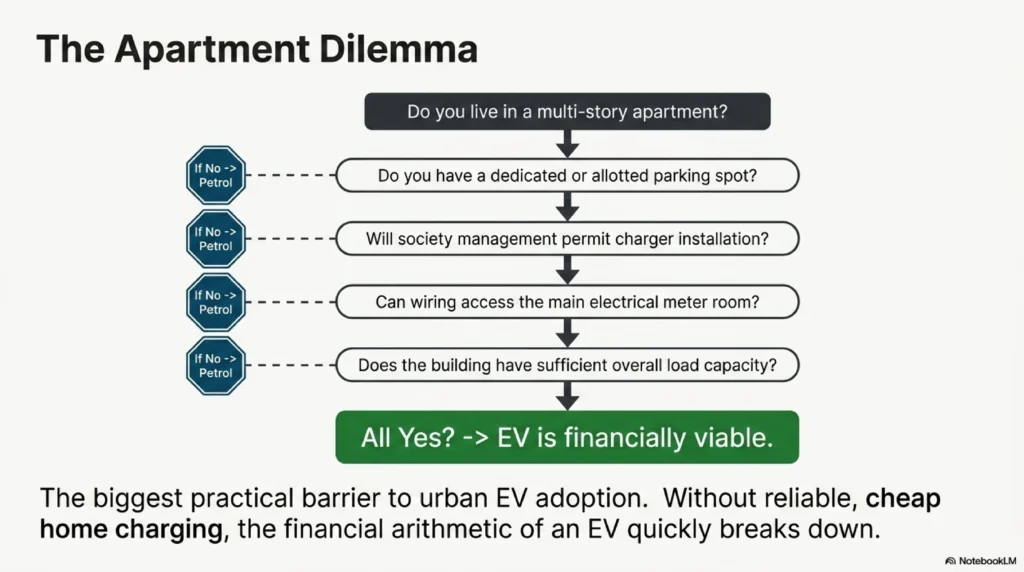
Apartment charging is one of the most searched EV-related topics in India right now, and with good reason. Before committing to an EV purchase, apartment residents should verify:
- Dedicated or allotted parking availability
- Society management permission for charger installation
- Electrical meter installation process and cost
- Wiring access from the meter room to your parking spot
- Building’s overall electrical load capacity
Several Indian states and housing authorities are now actively supporting EV charger installations in residential societies. Many housing societies in cities like Bengaluru, Pune, and Hyderabad have already installed shared charging setups. But confirmation before purchase is essential — do not assume.
When a Petrol Car Makes More Sense
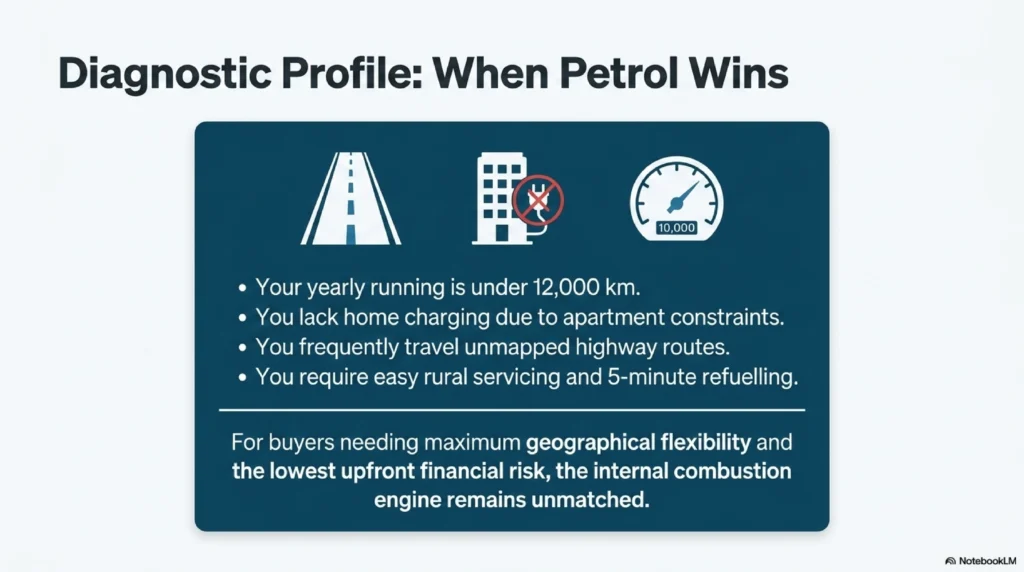
A petrol car is still the better practical choice if:
- You regularly travel long distances or make frequent highway trips
- You live in an area with limited public charging infrastructure
- You cannot install a home charger due to apartment constraints
- Your yearly running is low (under 10,000–12,000 km)
- You want the lowest possible upfront price
- You need easy rural servicing support
- You want the freedom to refuel in two minutes anywhere in India
For buyers purchasing their first car in smaller cities or towns, petrol remains practical and less risky.
When an EV Makes More Sense
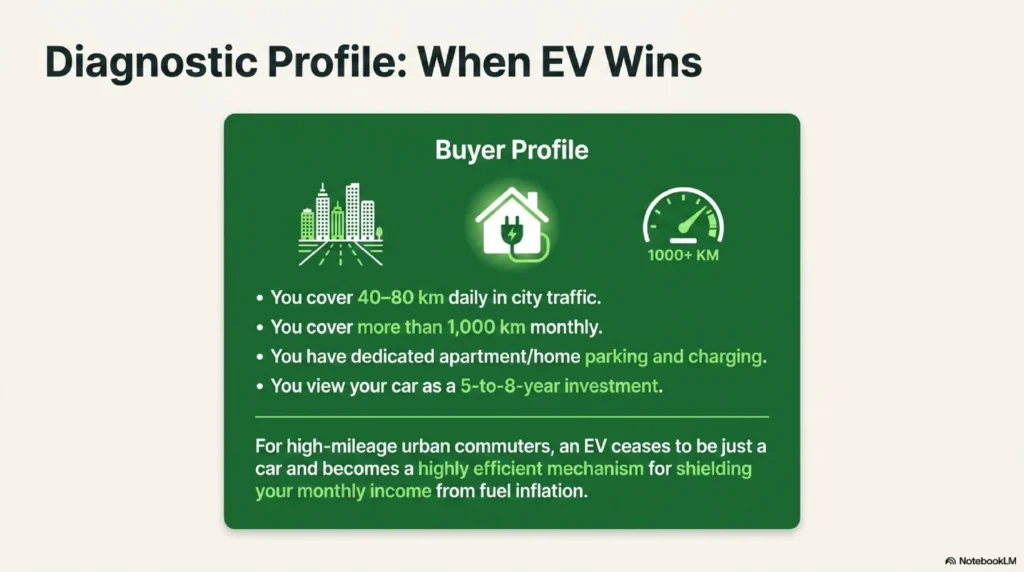
An EV is usually the better choice if:
- Most of your driving is within the city
- You cover more than 1,000 km monthly
- You have access to home charging
- You want lower monthly running expenses
- You prefer a smooth, quiet driving experience
- You already own a petrol or diesel vehicle for long trips
- You want lower annual maintenance bills
Many urban buyers now use EVs as their primary daily-use vehicle and reserve another car or a hired vehicle for occasional highway travel.
What the Next Few Years Look Like
India’s EV ecosystem is moving quickly. The near-term outlook includes better battery technology, longer ranges, faster DC charging speeds, more affordable entry-level EVs, and a growing used EV market.
Government policies — including FAME subsidies, GST reductions, and state-level incentives — continue to support adoption. Several new EV models from Tata, Mahindra, MG, Maruti, and Hyundai are expected to add more options across price segments.
At the same time, petrol vehicles are not going anywhere soon. India remains a large petrol and strong-hybrid market, particularly outside major cities. Both technologies will coexist comfortably for the next decade.
The Honest Verdict
There is no single answer that fits every Indian buyer.
If your driving is mostly within the city and you can charge at home, an EV can save a substantial amount over time. The low running costs, minimal maintenance, and smooth driving experience make it a genuinely compelling choice for urban users who cover decent distances monthly.
If you regularly drive long distances, live where charging infrastructure is thin, or cannot reliably charge at home, a petrol car still offers unmatched convenience and lower financial risk upfront.
In plain terms:
- Choose an EV for city efficiency and long-term savings.
- Choose a petrol car for flexibility, easy long-distance travel, and simpler rural usability.
The real advantage for Indian buyers today is that both categories now have strong, well-supported options worth considering.
Still Confused? or have more questions? You should go through this EV Basics Guide as a first time buyer.
Frequently Asked Questions
Is EV cheaper than petrol in India?
Running cost, yes — significantly. EVs typically cost ₹1–₹2 per km when charged at home, compared to ₹7–₹10 per km for a petrol car. The upfront purchase price is higher for EVs.
What is the average EV running cost per km in India?
Around ₹1 to ₹2 per kilometre for home charging. Public fast charging pushes this closer to ₹3–₹4 per km.
How long do EV batteries last in Indian conditions?
Most modern EV batteries are designed to last 8 to 10 years or more, with gradual capacity loss. Indian heat and frequent charging cycles can affect this marginally, but most manufacturers offer 8-year or 1.6 lakh km warranties.
Are EV maintenance costs really lower?
Yes. Fewer moving parts mean fewer things to service. Annual service costs for most EVs in India run ₹3,000–₹6,000, compared to ₹7,000–₹12,000 for petrol cars.
What is the break-even period for buying an EV in India?
For most urban buyers driving 1,200 km or more per month with home charging, the break-even is typically four to five years.