
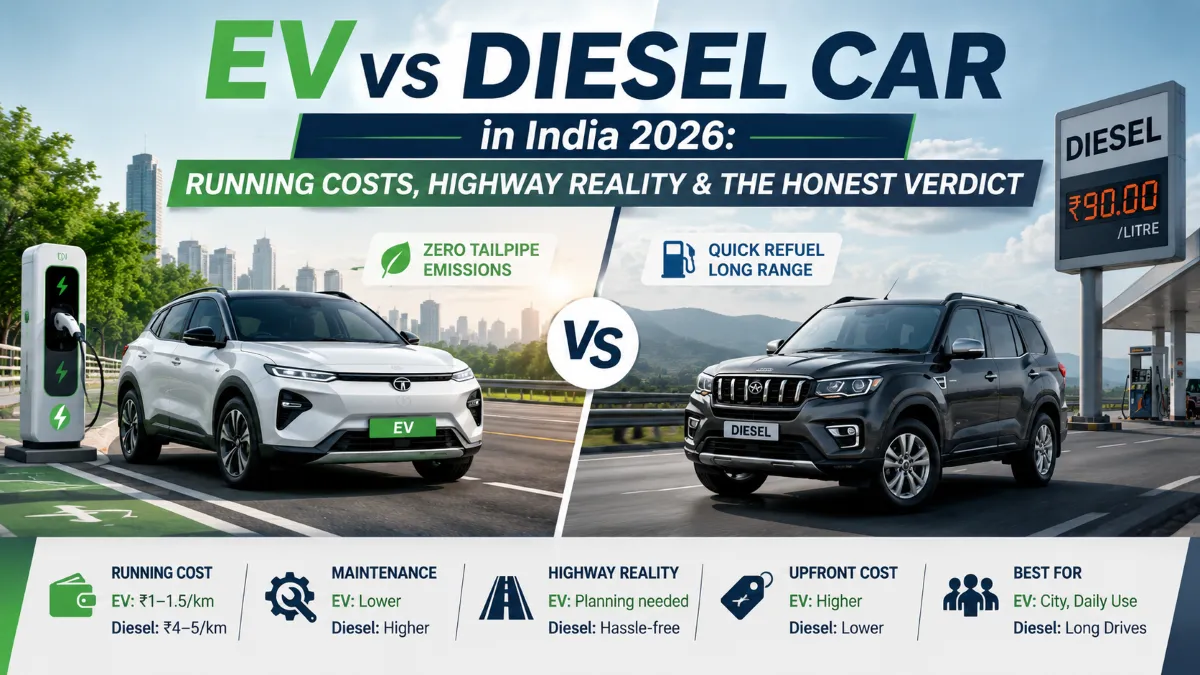
EV vs Diesel may be a question flashing often on your mind as Electric vehicles are no longer a surprise on Indian roads. Cities like Bengaluru, Delhi, Pune, Hyderabad, and Ahmedabad now have a visible EV presence — from Tata Nexon EVs in apartment parking lots to MG Windsor taxis running on city routes.
But diesel cars are not stepping aside quietly. For lakhs of Indian families who regularly cover long distances, haul heavy loads, or live in areas where charging infrastructure is still thin, diesel continues to earn its place.
So the real question in 2026 is not which technology is objectively superior. It is which one suits your driving pattern, your city, and your monthly budget better.
This comparison covers every factor that actually matters for Indian buyers — upfront cost, running cost, maintenance, city driving, highway usability, regulations, and long-term ownership.
EV vs Diesel: At a Glance
| Factor | Electric Car | Diesel Car |
|---|---|---|
| Upfront Price | Higher | Lower |
| Running Cost | ₹1–₹1.5 per km | ₹4–₹5 per km |
| Maintenance | Lower | Higher |
| City Driving | Excellent | Not ideal for short runs |
| Highway Travel | Improving, needs planning | Excellent |
| Refuel / Charge Time | 30 min–overnight | 5 minutes |
| Noise and Refinement | Very smooth, silent | Noticeable engine noise |
| Tailpipe Emissions | Zero | Higher |
| Long-Term Regulations | Future-ready | Increasing restrictions |
Upfront Cost: Diesel Starts Cheaper
At the showroom, diesel cars still cost less than equivalent EVs. The main reason is battery cost — lithium-ion packs remain expensive to manufacture, and that cost gets passed on.
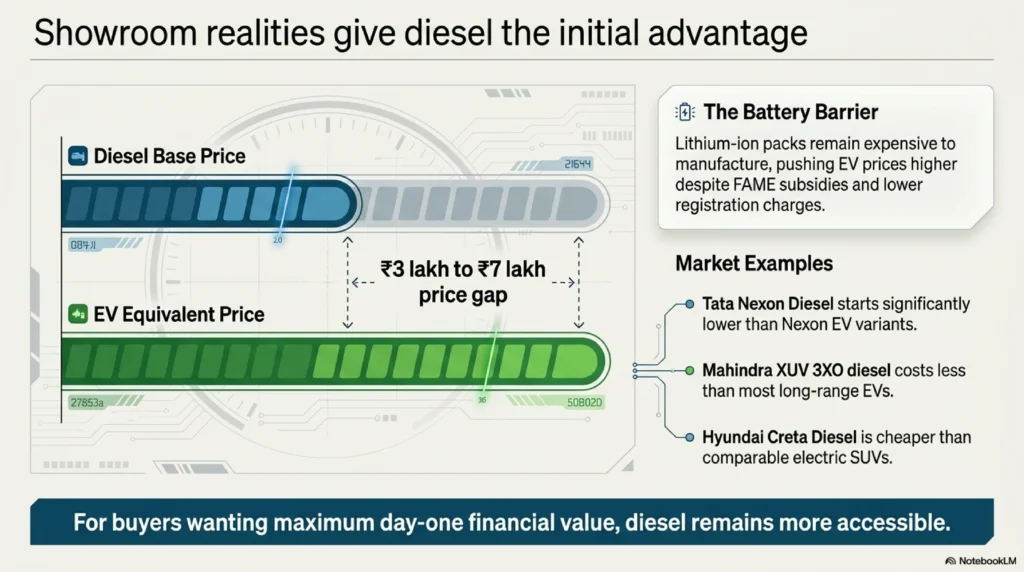
A few familiar examples from the Indian market:
- Tata Nexon Diesel starts significantly lower than the Nexon EV variants
- Mahindra XUV 3XO diesel costs less than most long-range EVs
- Hyundai Creta Diesel is cheaper than comparable electric SUVs
Depending on battery size and segment, the price gap between an EV and a diesel equivalent typically ranges from ₹3 lakh to ₹7 lakh.
State-level incentives, lower registration charges, and FAME subsidies narrow this gap somewhat for EV buyers, but the difference at purchase remains real. For buyers with a tight budget who want maximum value on day one, diesel still feels more accessible.
Running Cost: EVs Win This Round Clearly
This is where the EV case becomes very hard to argue against.
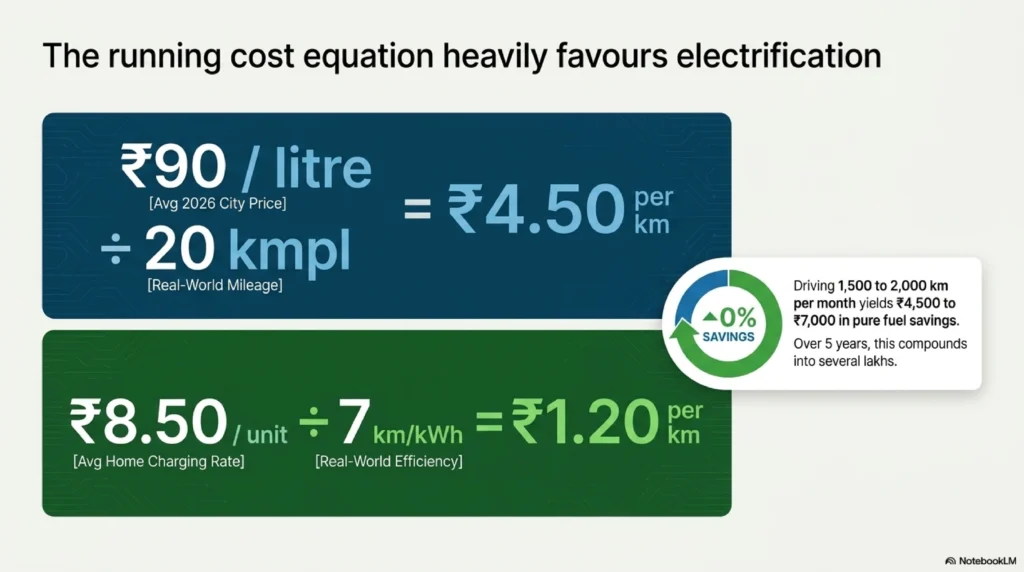
Diesel car cost per km
- Diesel price in most Indian cities in 2026: around ₹90 per litre
- Real-world mileage: 18–22 kmpl
- Effective cost per km: roughly ₹4 to ₹5
EV cost per km
- Home charging rate in most Indian cities: ₹7–₹10 per unit
- Average real-world efficiency: 6–8 km per kWh
- Effective cost per km: roughly ₹1 to ₹1.5
For someone driving 1,500 to 2,000 km every month, the monthly saving on fuel alone is around ₹4,500 to ₹7,000 compared to diesel. Over five years, that adds up to several lakhs.
If your daily commute is high and you have home charging access, the financial case for an EV over diesel is straightforward.
Maintenance: Diesel Engines Need More Attention
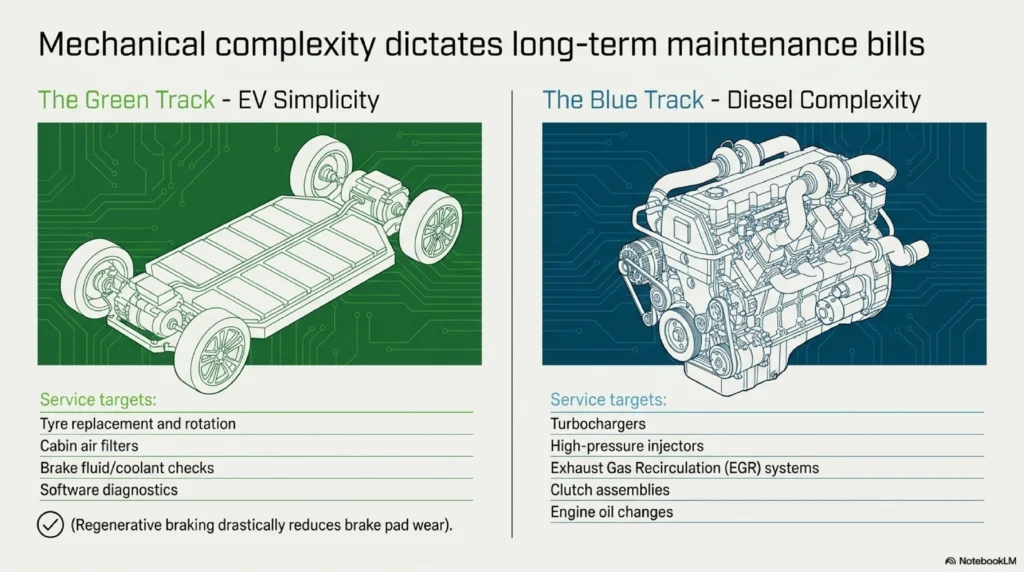
Diesel engines are mechanically complex. Modern diesel cars include turbochargers, DPF filters, high-pressure injectors, EGR systems, and clutch assemblies. Each of these adds to servicing cost and potential repair bills over time.
There is another specific problem for Indian city users: diesel engines and their DPF systems are designed for sustained highway running. Constant short-distance city trips — which are the norm in Mumbai, Delhi NCR, Bengaluru, and Pune — can cause the DPF to clog because the engine never gets hot enough to regenerate it properly. That can mean expensive repairs.
EVs avoid most of this entirely. With no engine oil, no clutch, no traditional gearbox, and regenerative braking reducing brake wear, EV owners mainly deal with:
- Tyre replacement and rotation
- Brake fluid checks
- Cabin air filter replacement
- Coolant level checks
- Software diagnostics
For city users especially, EV maintenance is noticeably cheaper year on year.
City Driving: EVs Are Simply More Comfortable
In Indian stop-and-go traffic, an EV feels like a different product category.
The instant torque response makes overtaking and merging smooth. There is no gear hunting, no engine shudder at idle, and no vibration at low speeds. The cabin stays quiet even when traffic is not moving. During peak hour crawls in cities like Mumbai or Bengaluru, this matters more than most buyers realise until they actually drive one.
Diesel cars still offer strong pulling power — especially useful when the car is fully loaded with five passengers and luggage — but for solo or small-family daily commuting in city traffic, the EV driving experience is noticeably more refined.
Highway Travel: Diesel Remains More Practical
This is the clearest area where diesel continues to hold its ground.
A well-driven diesel SUV can cover 800 to 1,000 km on a full tank. Fuel stations are available everywhere in India, including state highways, small towns, and remote hill routes. Refuelling takes five minutes. There is no need to open an app, check charger availability, or wait.
EV highway travel in 2026 is far better than it was two or three years ago, but it still requires planning. You need to check:
- Fast charger availability on your specific route
- Whether those chargers are functional and not occupied
- Charging time at each stop
- How speed and AC usage affect your range
Models from Tata, Mahindra, MG, Hyundai, and BYD now offer much better highway range and India-specific software improvements, but for buyers who frequently drive more than 400 km in a day or travel on less-covered state highways, diesel still offers significantly more confidence and convenience.
Range Confidence vs Charging Flexibility
Part of why diesel remains popular is the psychological comfort of knowing you can stop anywhere and be back on the road within minutes.
With a diesel car:
- Refuel in 5 minutes at any petrol pump
- No dependency on charging apps or networks
- No waiting for a charger to free up
With an EV:
- Fast charging still takes 30–60 minutes at a DC charger
- Rural and smaller-town charging coverage remains inconsistent
- Apartment charging can be difficult without dedicated parking
That said, for urban buyers who charge overnight at home, range anxiety typically fades within the first month of ownership. When you start every morning with a full battery, daily driving stops feeling like a logistical calculation.
Emissions and Regulations: The Long View
EVs produce zero tailpipe emissions. That directly benefits air quality in Indian cities, many of which — Delhi, Mumbai, Pune, Ahmedabad — already deal with poor air quality during winter months and high-traffic periods.
Diesel vehicles emit NOx, particulate matter, and greenhouse gases. Older diesel vehicles in Delhi NCR already face age-based restrictions, and similar policies are being discussed in other cities. The policy direction at both central and state government levels clearly favours electrification over the long term.
This does not mean diesel cars will become unviable immediately. For highway-heavy users and commercial applications, diesel will remain practical for years. But buyers planning to keep a vehicle for 8–10 years should factor in the possibility of stricter urban regulations down the line.
EV vs Diesel Over 5 Years: Who Saves More?
The break-even calculation depends almost entirely on how much you drive.
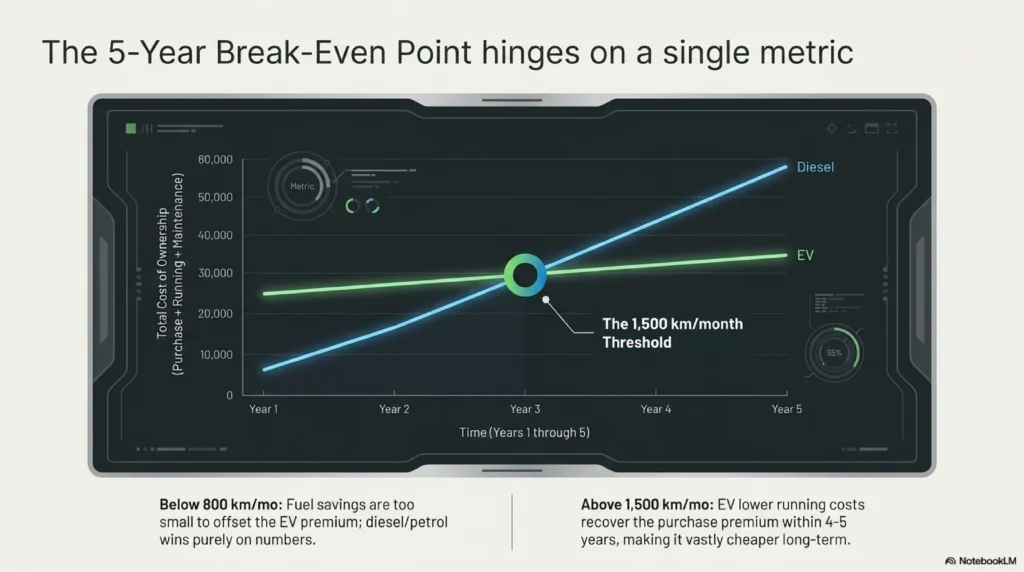
For high-mileage users — 1,500 km or more per month — the lower running and maintenance costs of an EV begin recovering the higher purchase price within four to five years. Beyond that point, the EV is the clearly cheaper vehicle to own.
For low-mileage users driving under 700–800 km monthly, the fuel savings are smaller and the break-even point stretches further. In those cases, diesel or even petrol may make better financial sense purely on numbers.
Your actual monthly driving distance matters far more than any general recommendation.
Common Misconceptions Worth Clearing Up
Myth: “EV batteries fail quickly”
Reality: Modern EV batteries are considerably more durable than earlier generations. Most manufacturers now offer 8-year or 1.6 lakh km battery warranties as standard. Gradual degradation happens, but outright failure in the first several years is rare.
Myth: “Diesel cars are already dead”
Reality: Not in India. Diesel works extremely well for highway-heavy users, commercial vehicles, and buyers in areas with limited EV charging. It is not a declining technology for all use cases.
Myth: “EVs cannot handle Indian summer heat”
Reality: Most EVs sold in India today include battery thermal management systems specifically designed for high-temperature climates. Indian summer heat does affect charging efficiency marginally, but modern packs handle it far better than older EV generations.
Myth: “Apartment charging is impossible”
Reality: Many housing societies in Bengaluru, Pune, Hyderabad, and Delhi NCR have already installed shared EV charging setups. Older societies in smaller cities remain a challenge, but it is worth checking your specific situation before assuming it cannot be done.
Which One Should You Choose?
Here is a simple algorithmic representation that will help you to choose easily between EV and Diesel vehicle depending upon your current situation:
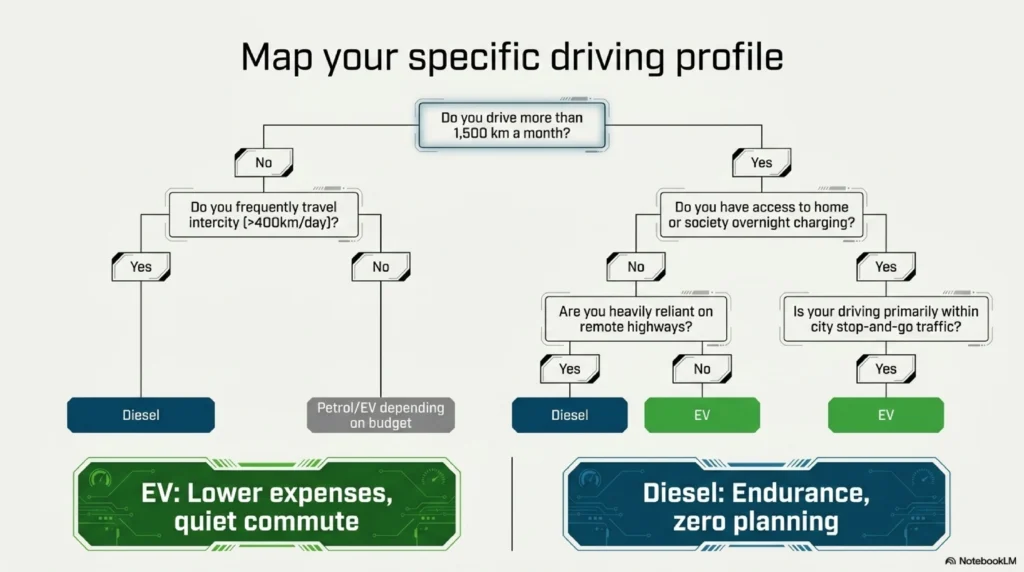
An EV makes more sense if:
- Your driving is mostly within the city
- You cover 1,000 km or more monthly
- You have home or society charging access
- You want lower monthly expenses and quieter driving
- You are planning to keep the vehicle for 6–8 years or more
- You already have a petrol or diesel vehicle for highway trips
A diesel car still makes more sense if:
- You frequently travel on highways or intercity routes
- You regularly drive more than 400 km in a day
- You live in areas where charging infrastructure is sparse
- You carry heavy loads or travel with full occupancy frequently
- You want quick refuelling with zero planning overhead
- Your monthly driving is below 700–800 km
Still wobbling around different thoughts? Then you should read EV Basics Guide for first time buyers here:
The Honest Bottom Line
Neither EV nor diesel is the universal answer for every Indian buyer.
If you are a city-based commuter with home charging and decent monthly mileage, an EV will likely save you meaningful money over five to eight years while delivering a noticeably better daily driving experience.
If you are a frequent highway traveller, live in a smaller city or town with limited charging, or simply cannot manage home charging, a diesel car still offers real advantages that cannot be wished away by fuel cost calculations alone.
Calculate your actual monthly distance, check your charging feasibility, factor in your typical routes, and decide based on that — not on what is trending on social media.
Frequently Asked Questions
Is EV cheaper than diesel in India?
Running cost and maintenance, yes — significantly. EVs cost ₹1–₹1.5 per km at home charging rates versus ₹4–₹5 per km for diesel. The upfront purchase price remains higher for EVs.
Is diesel better for long-distance travel?
Yes, currently. Quick refuelling, wider fuel station availability, and longer single-charge range make diesel more practical for frequent highway driving in India.
Which has lower maintenance costs: EV or diesel?
EVs, clearly. Fewer mechanical parts and no engine-related servicing mean annual maintenance bills are typically half or less of what a diesel car requires.