
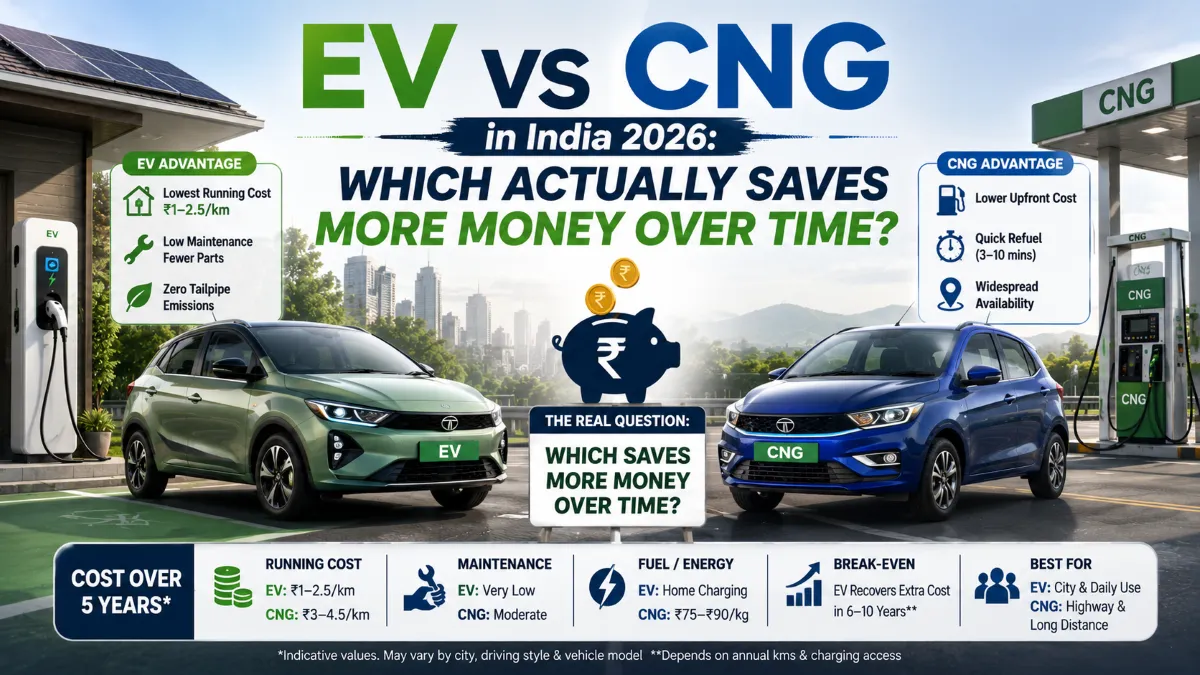
EV vs CNG!! An exciting comaprison. Electric vehicles and CNG cars are currently the two most practical options for Indian buyers trying to cut down running costs. With petrol prices staying volatile and city air quality worsening every summer, both options have strong arguments in their favour.
But the real answer is never just about fuel prices. Your daily driving distance, whether you live in an apartment or independent house, your city’s charging network, and how long you plan to keep the vehicle — all of these change the math considerably.
This comparison covers running costs, maintenance, everyday practicality, long-distance travel, and total ownership economics to help you decide which makes more sense in 2026.
EV vs CNG: Side-by-Side at a Glance
Here is a clear visual table to get the facts straight in current scenario:
| Factor | Electric Vehicle | CNG Car |
|---|---|---|
| Purchase price | Higher | Lower |
| Running cost per km | Lowest | Low |
| Maintenance cost | Very low | Moderate |
| Home refuelling | Yes | No |
| Long highway trips | Improving | Excellent |
| Refuelling time | 30 min to a few hours | 3–10 minutes |
| Tailpipe emissions | Zero | Low |
| Government incentives | Available in some states | Limited |
| City driving experience | Smooth, silent, no gearshifts | Similar to petrol with slight lag |
| Best suited for | Daily city driving | Mixed city and highway use |
Running Cost: Where EVs Pull Ahead
For most buyers, the question comes down to this: which one saves more money across five to ten years? The answer lies in total ownership cost, not just fuel bills.
EVs typically cost more upfront because batteries remain the single most expensive component. CNG conversions or factory-fitted CNG models usually add only ₹80,000 to ₹1.5 lakh over the petrol variant. However, EVs recover a significant portion of this premium through lower running and maintenance costs.
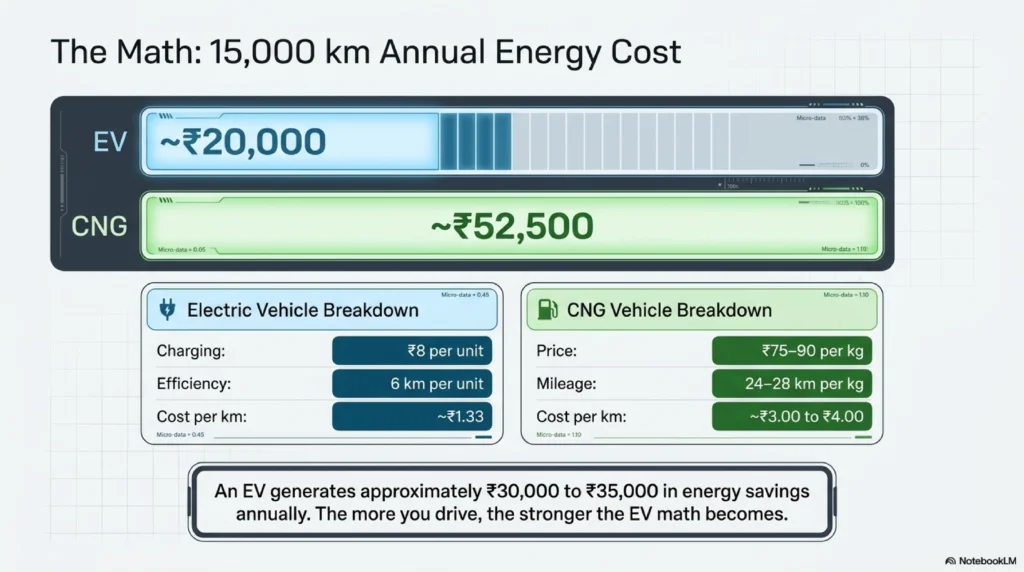
Cost Per Kilometre
Electric Vehicle
- Charging cost: ₹8 per unit
- Efficiency: 6 km per unit
- Cost per km: approximately ₹1.33
Home charging in states with lower electricity tariffs — Maharashtra, Gujarat, Karnataka — can reduce this even further.
CNG Car
- CNG price: ₹75–90 per kg (varies by city)
- Mileage: 24–28 km per kg
- Cost per km: approximately ₹3 to ₹4
Annual Cost Example EV vs CNG (15,000 km/year)
| Vehicle | Calculation | Annual Cost |
|---|---|---|
| EV | 15,000 × ₹1.33 | ~₹20,000 |
| CNG | 15,000 × ₹3.50 | ~₹52,500 |
Annual savings with an EV: approximately ₹30,000 to ₹35,000 in energy costs alone.
The more you drive, the stronger the case for an EV.
Use our EV Savings Calulator to evaluate the savings against each fuel type (Petrol/Diesel/CNG):
Maintenance: EVs Win Here Too
A petrol or CNG engine contains hundreds of moving parts. A CNG vehicle still needs:
- Engine oil and filter changes
- Spark plug replacement
- Air filter servicing
- Clutch maintenance
- CNG kit inspections
- Emission checks
An EV has none of these. Routine EV maintenance typically covers:
- Tyre rotation and replacement
- Brake fluid top-up (brakes also last longer thanks to regenerative braking)
- Cabin air filter
- Coolant checks on applicable models
Over five years, EV owners commonly spend 30% to 50% less on servicing than CNG owners. For cars like the Tata Nexon EV or MG Windsor, real-world ownership feedback consistently points to lower service bills compared to equivalent CNG sedans or hatchbacks.
City Driving: EVs Are Built for Indian Traffic
Indian urban traffic is, frankly, ideal for electric vehicles. Stop-and-go movement through city roads, slow-crawling during peak hours, and the heat of an Indian summer inside a CNG car all add up to a frustrating ownership experience.
EVs handle city conditions with:
- Instant torque from standstill
- No clutch, no gear changes, no engine noise
- Regenerative braking that recovers energy during every deceleration
- Zero tailpipe emissions — relevant if you drive through congested areas daily
For daily usage under 80–100 km, modern EVs from Tata, MG, or Hyundai are often more convenient than a CNG car. Most owners simply plug in overnight and leave home every morning on a full charge.
Highway Driving: CNG Still Holds a Practical Edge
This is where CNG cars genuinely have the upper hand.
- Refuel in 3–10 minutes at any CNG station
- Better range continuity on long routes
- No requirement to plan charging stops
- CNG pumps available across most national highways
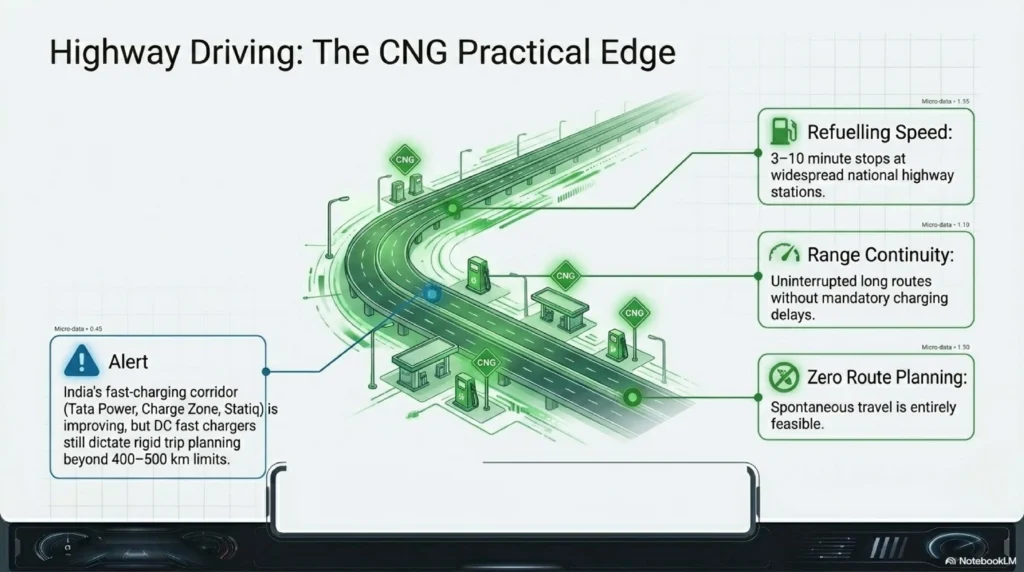
India’s fast-charging network has improved noticeably — Tata Power, Charge Zone, and Statiq have expanded corridor coverage — but DC fast chargers still require planning on routes beyond 400–500 km.
A Hyundai Creta Electric with 450+ km claimed range changes the calculus somewhat, but if you regularly drive from Bhopal to Indore and back and then head out again the next morning, a CNG car remains the simpler option today.
Charging vs Refuelling: It Depends on Your Living Situation
EVs are convenient if you have:
- Dedicated parking — independent house, gated society with charger access
- A 15-ampere socket nearby for overnight charging
- Access to public or workplace chargers as backup
EVs become inconvenient if:
- You live in an older apartment building without charging infrastructure
- You depend entirely on public chargers in a city where they are often occupied
- You need a quick turnaround between long trips
Here is EV charging cost calculator and EV charging time calculator for more help:
CNG is reliable if:
- There is a CNG station within a few kilometres of your regular route
- You are comfortable making fuel stops as part of your routine
One caveat on CNG: queue times at stations in cities like Delhi, Pune, and Mumbai can run 15–30 minutes during peak morning hours. That convenience advantage is not always as clean as it sounds.
Battery Life vs CNG System Durability: Clearing the Confusion
Battery replacement anxiety remains one of the most common concerns from first-time EV buyers. The reality in 2026 is different from what it was five years ago.
Most manufacturers now offer:
- 8-year or 1,60,000 km battery warranty (Tata, Hyundai, MG)
- Capacity retention guarantees (typically 70–80% over warranty period)
Real-world data from global markets shows batteries retaining substantial capacity well beyond the warranty period under normal use.
CNG systems also have long-term costs that are often overlooked:
- Injector wear and replacement
- Pressure regulator servicing
- Mandatory cylinder re-certification every few years
- Engine wear at higher mileage, since CNG combustion runs leaner
Neither technology is maintenance-free for life, but battery degradation fears for modern EVs are generally overstated.
Environmental Consideration
Both options are cleaner than petrol or diesel vehicles, but they differ in how.
EV: Zero tailpipe emissions. Indirect emissions depend on the electricity grid mix. India’s grid is increasingly cleaner as renewable capacity grows.
CNG: Low particulate emissions, reduced NOx compared to petrol, but still a fossil fuel with CO₂ output.
For urban air quality — which matters most in cities like Delhi or Bengaluru during winter smog or post-monsoon stagnation — EVs have a clear edge.
Who Should Buy What
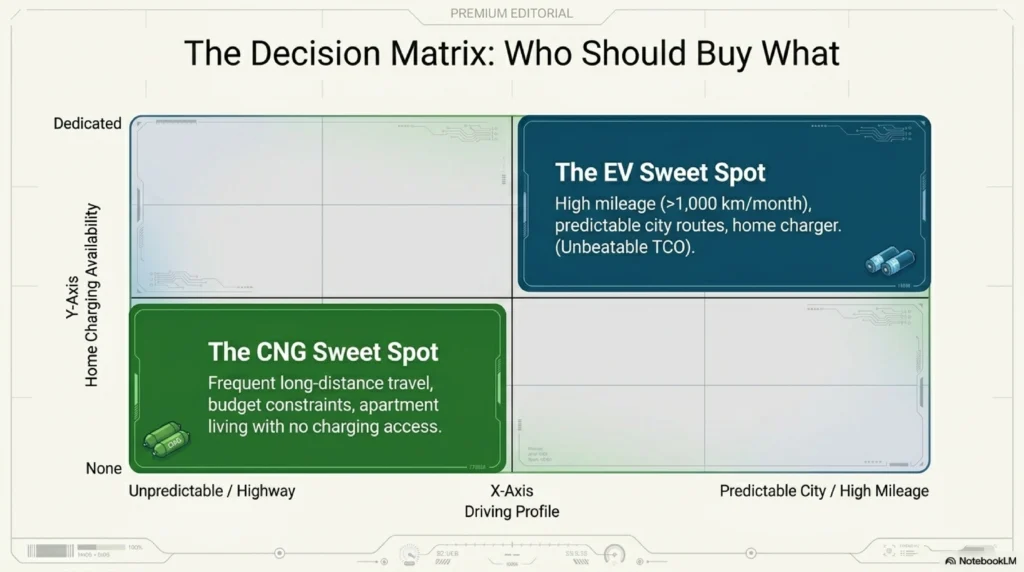
Buy an EV if:
- You drive more than 1,000 km a month
- You have access to home charging
- Most trips are city-based
- You plan to keep the vehicle for five or more years
- You want the lowest possible per-km running cost
First time buyers may be little more confused regarding EVs. Here is a detailed and Complete Guide for First Time EV Buyers.
Buy a CNG car if:
- Your upfront budget is limited
- You regularly travel long distances between cities
- CNG stations are conveniently located on your routes
- You live in an apartment where charging is not currently feasible
- Your driving is unpredictable and you prefer refuelling flexibility
Here is a clear illustration for choosing between EV vs CNG. Look at it and match it up with your current scenario:
The Honest Take
For most urban Indian buyers in 2026, an EV delivers the lowest total ownership cost over a five-year period. Cheap home charging, lower servicing bills, and a steadily improving fast-charge network make electric cars increasingly compelling for daily use.
CNG remains a genuinely strong choice for buyers who frequently drive long distances or cannot yet access reliable home charging.
Following is one more tabular illustration for a quick decision making:
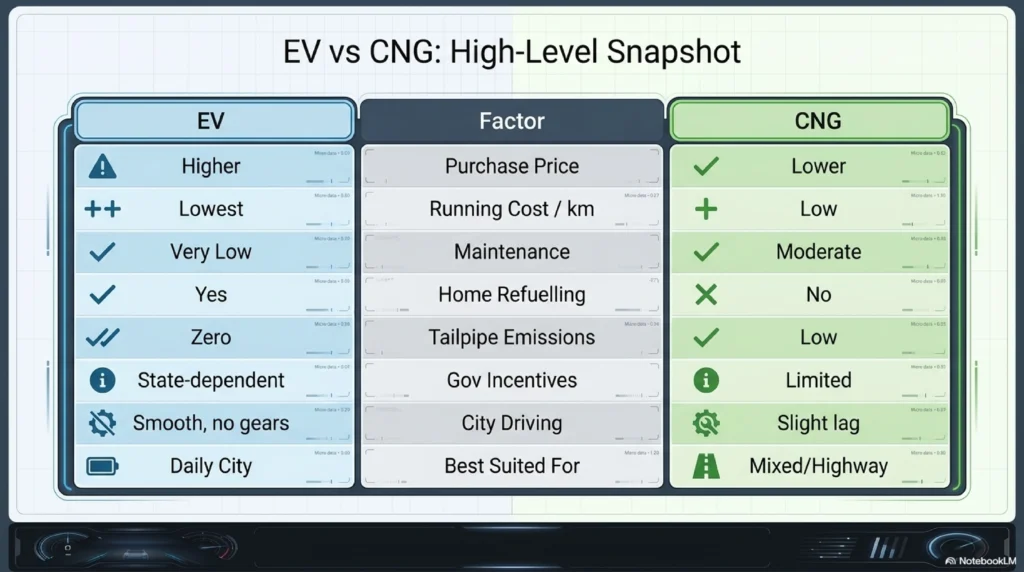
If your usage is primarily within the city and you can plug in at home, an EV will save more money over time. If your driving regularly involves interstate travel or unpredictable routes where charging is uncertain, a CNG car is still the more practical option today.
The gap is narrowing every year. But for city-based, home-charging EV owners, the ownership economics are already decisively in favour of electric.
Frequently Asked Questions
Is an EV cheaper than CNG in India?
On running and maintenance costs, yes. EVs cost significantly less per kilometre. The upfront purchase price is typically higher, though state subsidies and FAME-linked incentives reduce this gap in many states.
Which is better for long-distance travel?
CNG remains more practical for frequent highway travel because refuelling is faster and CNG stations are more widespread across national highways. EVs with 400–500 km range and fast charging are closing this gap, but trip planning is still necessary.
How much can an EV save compared to CNG annually?
For someone driving 15,000 km per year, an EV saves approximately ₹30,000 to ₹35,000 in energy costs alone. Savings on maintenance add further over time.